Monday, May 13, 2013

Break Out!

The captains of the CSS Albermarle and CSS Manassas called to each other with speaking trumpets as their ships maneuvered perilously close together.  "If'n we don't break through the Yankee cordon we'll end up burning 'em at their moorings."  It required no audible response to see that the two agreed on the inevitable result of the Yankee advance.  Already the Manassas had miraculously survived the fight at New Orleans in '62 and now, a tired old ironclad ram she faced final destruction in the company of the new cornfield-built Albemarle.  (New ships to the collection so they had to be blooded.)

Upriver the Yankee flotilla waited. The flag was in the USS Essex, a casement ironclad veteran of many combats, accompanied by the USS Cairo a "Pook Turtle." An Ellet Ram, the USS Mingo trailed the Cairo. Unarmed except for a huge ram she represented in many ways the biggest threat to the Rebel warships given her speed and ram. One of the 90-Day Gunboats trailed the Essex.

The scene as the Rebel ships looked down the river.  Open water is off camera to the right.  The plan was to get the Yankees to commit then steer right around the double level island.  Only problem was all the Yankee ships were faster than the Confederate.  First hit of the game went to the Albemarle's forward 6.4" Brooke Rifle.

The Yankee return fire, though plentiful was less than effective.


As the Reb ships started their turn the Yankees vigorously followed.  Meanwhile the Ellet Ram lurked in the waters ahead.

Yankee fire remained largely ineffective as all ships focused on the Albemarle.  And why not?  With only one gun and that forward firing, the Manassas was no threat.  Still, the Albemarle's gunners were hot and did major damage to the stacks of the Cairo, slowing her hugely.

As we made the turn the Yankee fire became more effective.  Although quickly having the fight move away from her the Cairo put hits on both ships and the Essex was steadily closing to where her smoothbore cannons would be effective.

Eager to enter the fight the 90-Day gunboat misjudged her turn and grounded off shore.  Better than running fully onto the shore, she could at least pull off in time.  Meanwhile, the Essex struck the Albemarle a glancing blow which did no damage.  The Mingo and Albemarle then went head to head with the Mingo springing a leak while the Albemarle carried on.  The Manassas then got to ram the Essex while firing her 68 pounder point blank, but again the ram was ineffective and she just slide down the side.

The Essex now lost her stacks and was reduced to one knot of speed, just like the Cairo.  If the Rebs could get past it was clear sailing to new waters!
Alas, with the speed lost in the glancing ram attempt and her natural slowness the Manassas took too long to clear the Essex.  The latter's 42 pounds pounded the port side of the Manassas till her armor was breached and a fire broke out.  One which escalated as damage control failed.  Small consolation was the Gunboat over-taxing her engines and blasting her steam skyward.

As a parting blow the Manassas rammed the Mingo and opened up the flood waters.  Unfortunately the Manassas was now a raging inferno and only the river waters could put out the fires.  As the crew desperately tried to staunch the flow of water into the hull of the Mingo his captain took the only only course available and ran her aground.  As smoke and steam marked the final rest of the Manassas the Albemarle decided against being a hero and steamed off, no doubt to find her fate another time.

So in the end the Albemarle escaped and the Manassas was lost.  Considering she was actually lost in '62 maybe not such a bad result.  The Mingo might not be reconstructed given the level of damage, while the Cairo and Essex would be out of action for some time, each reduced to one knot of speed.  The captain of the gunboat could look forward to endless teasing from his fellow captains.

Rules are "Steam and Black Powder" by Neil Stokes, published by the St. Paul Irregulars.  Playing time was a bit over two hours with part of that spent explaining game nuances to the player new to the rules.


Tuesday, May 7, 2013

A weekend of gaming

To help Bill Protz celebrate his belated birthday, a group gathered for gaming, good conversation and dice rolling.  In the morning the 17th Bengal Lancers needed to do a reconnaissance from Fort Grant to determine if the Thugees under the mighty Khan were approaching.  I volunteered to share referee duties with another during the scenario.  The Thugs had a 24' table to work with and placed their troops on a map.  The lights were then turned off to simulate a pre-dawn march and we saw how far they could move in ten minutes before the lights came up. 

The Thugs decided to deploy forward to ambush the troopers right away, presumably before they could gather any military intelligence.  Personally, I would have held them back, in the gaps between the woods, maybe with a unit dismounted and facing the rear to shoot lancers in the back after they rode past.  But, they attacked right away and after two turns we refs had nothing to do.  So we amused ourselves developing special rules for things like this:

At first it looked very difficult for the lancers, with enemy cavalry on all flanks.

But the advantage of close-order troops vs. open order and the lance bonus on first contact meant in the end that although the reconnaissance was defeated, the cost to the Thugee cavalry was huge.  Fire from the battlements of the fort and a sortie by infantry in support also brought grief to the Khan's forces.  I'll leave other commentary to the players.

After very pleasant lunch and delicious birthday cake the group divided for two games.  The first was the assault on Fort Grant by Khan and his Thugs.  Although I thought I took pictures none turned out.  I'll leave it to Bill or others to report on the desperate fighting after the walls were breached and the Thugs entered the fort.

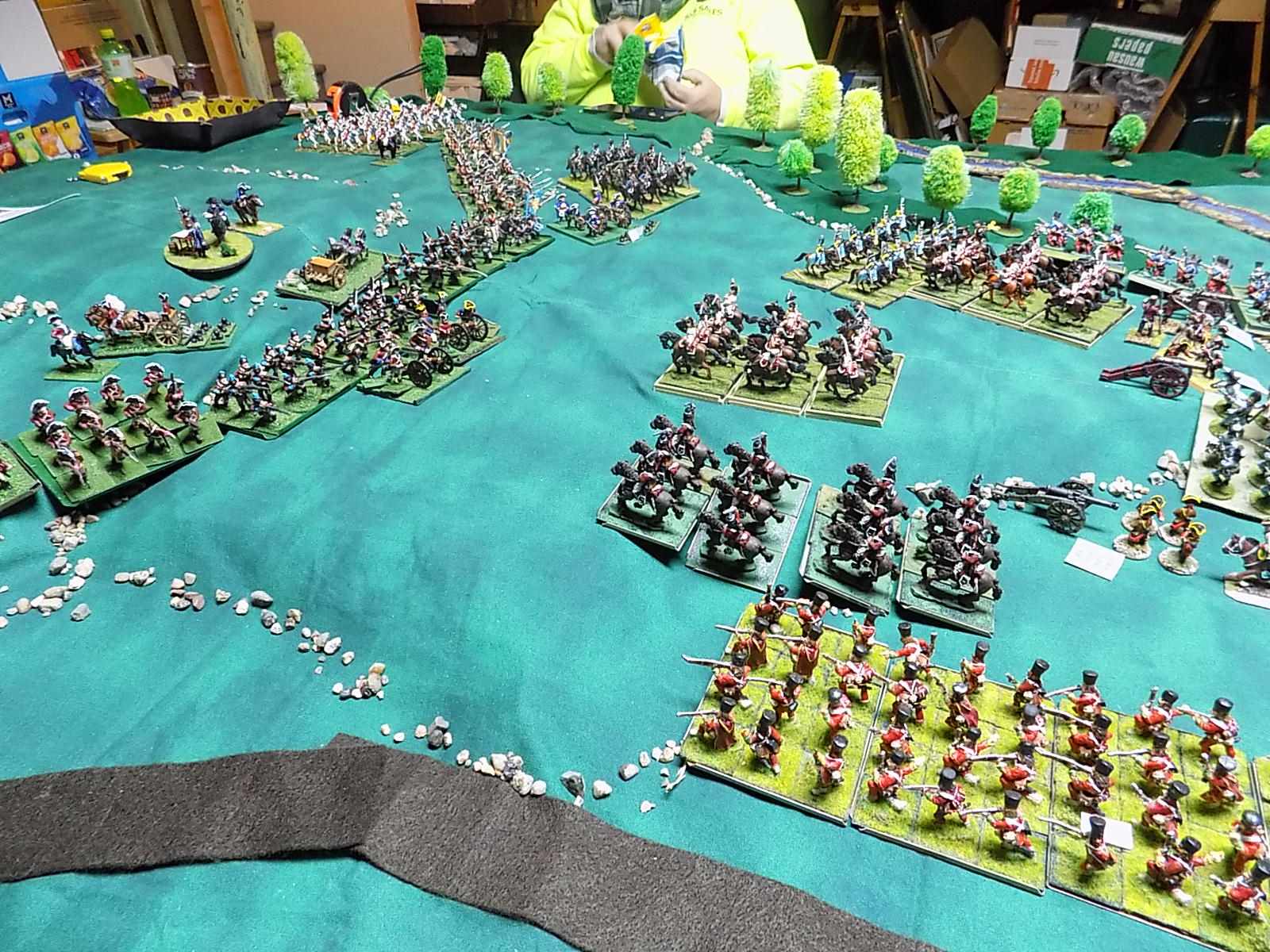
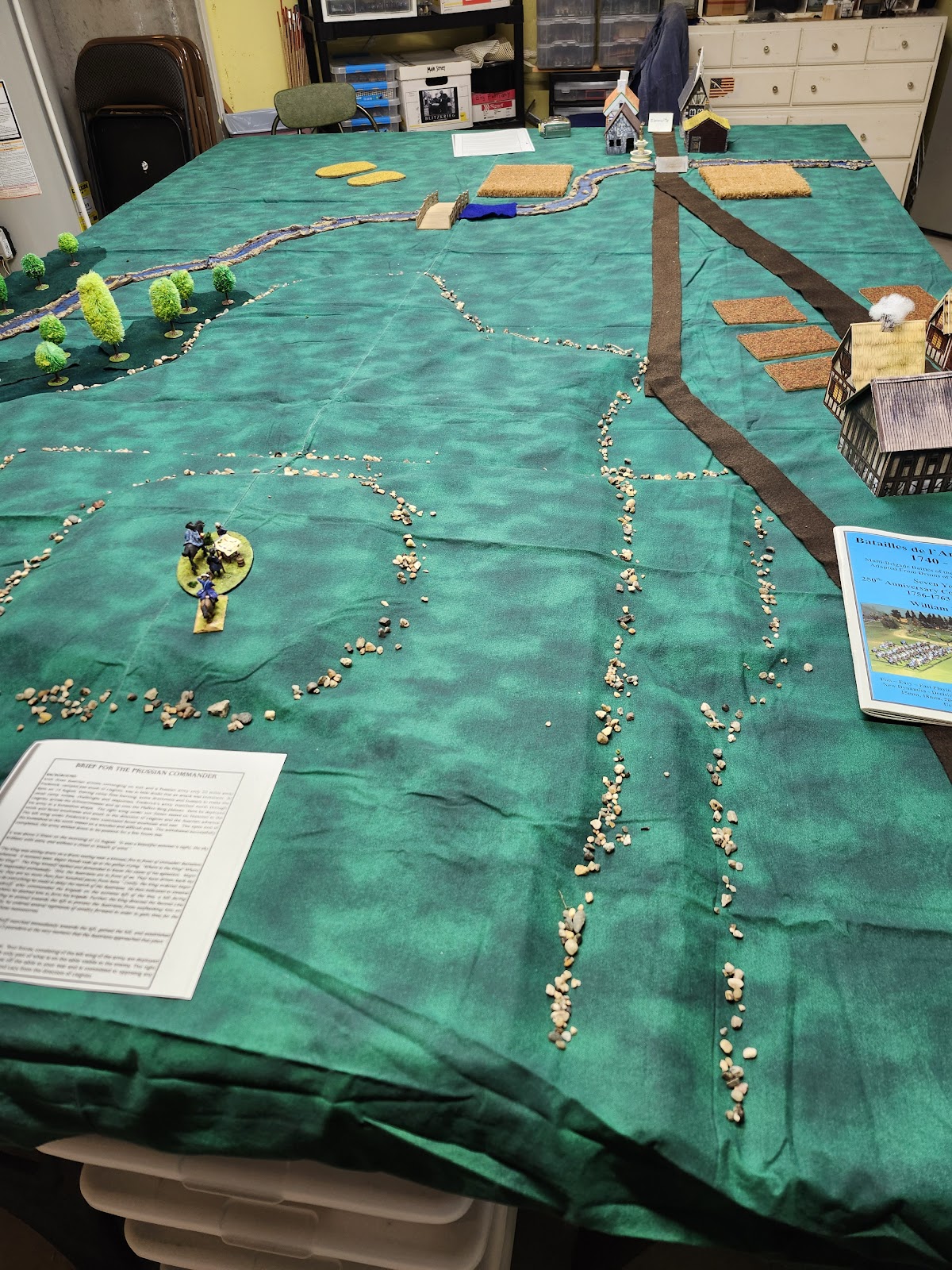
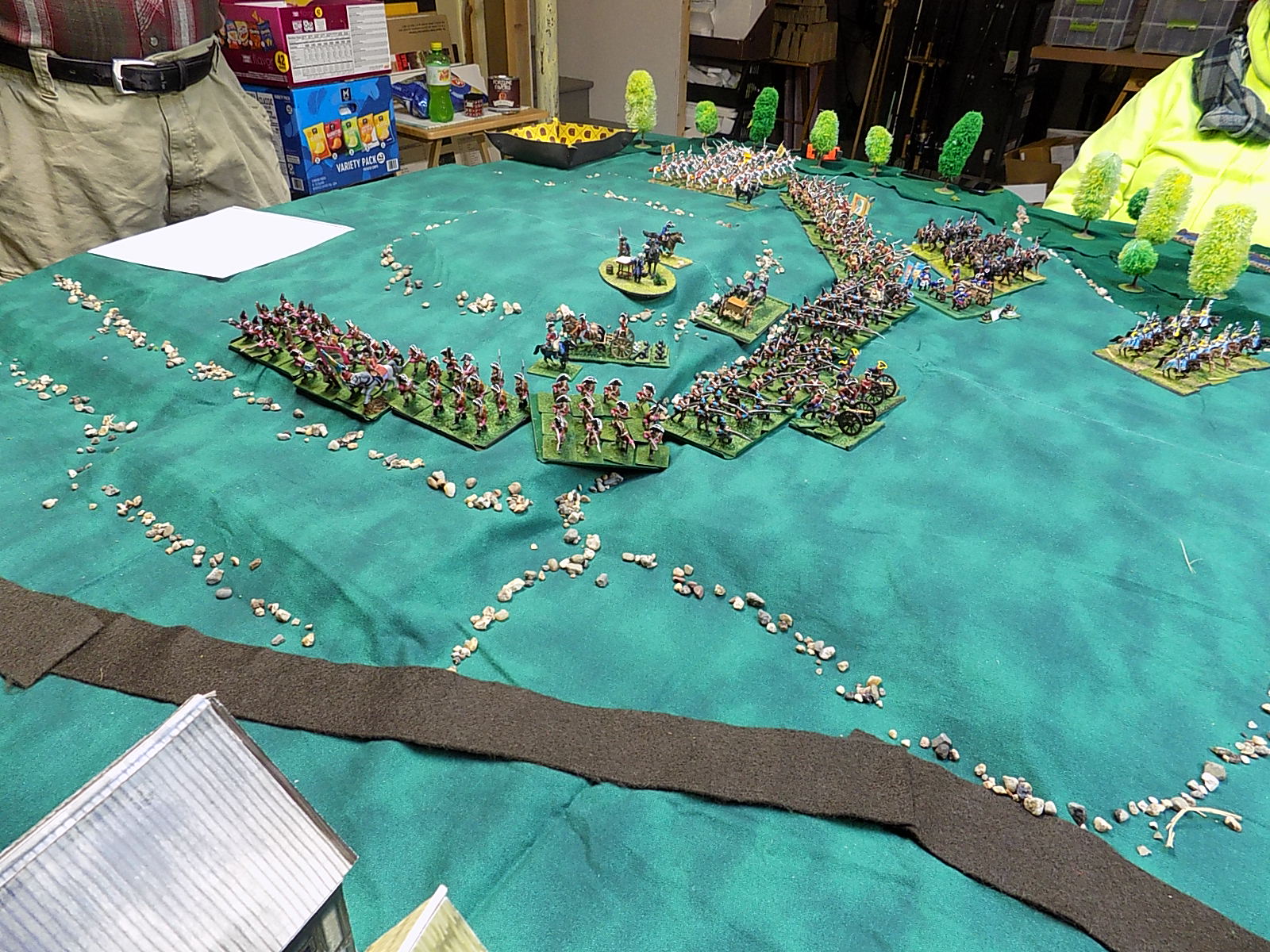
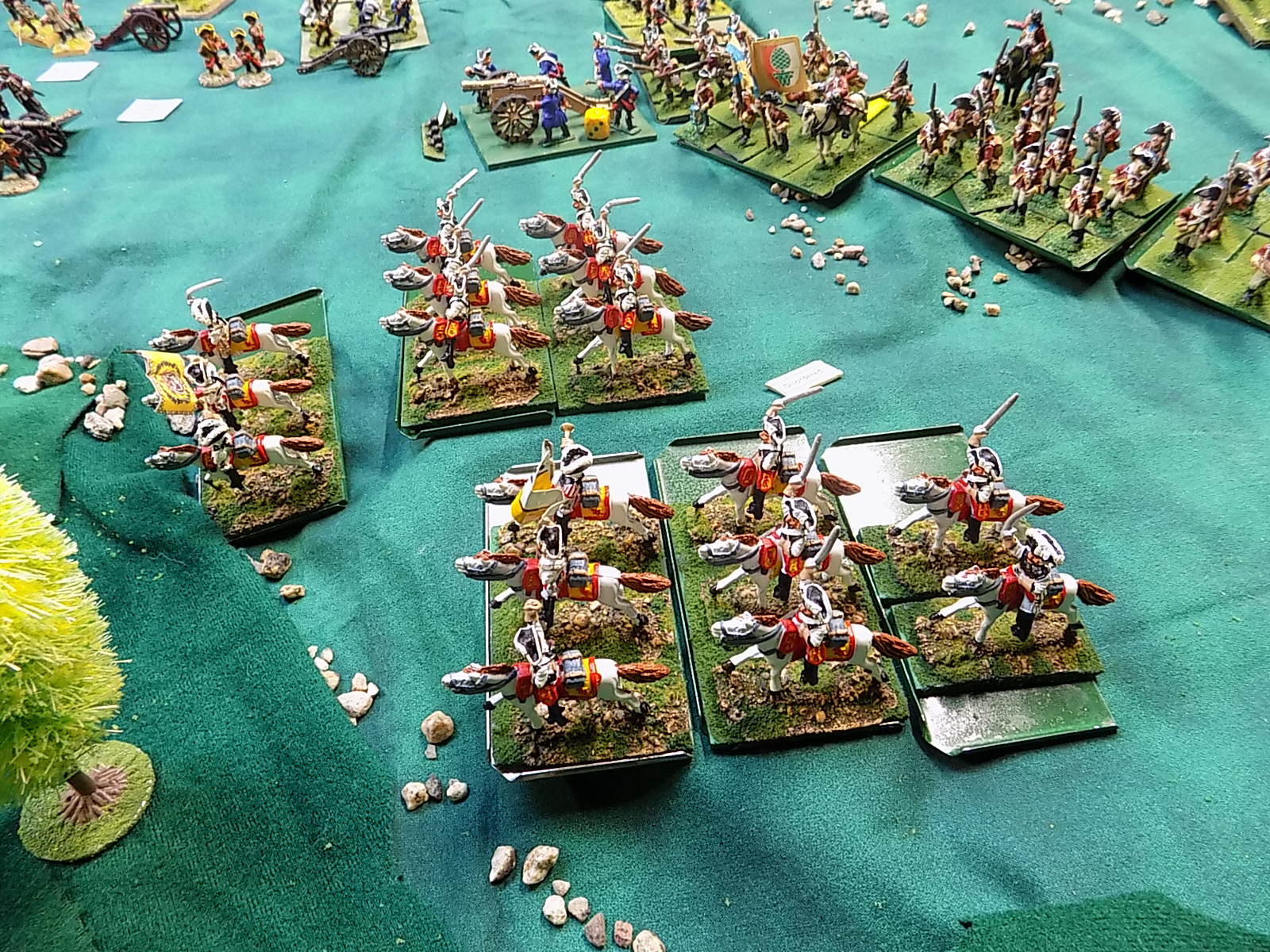
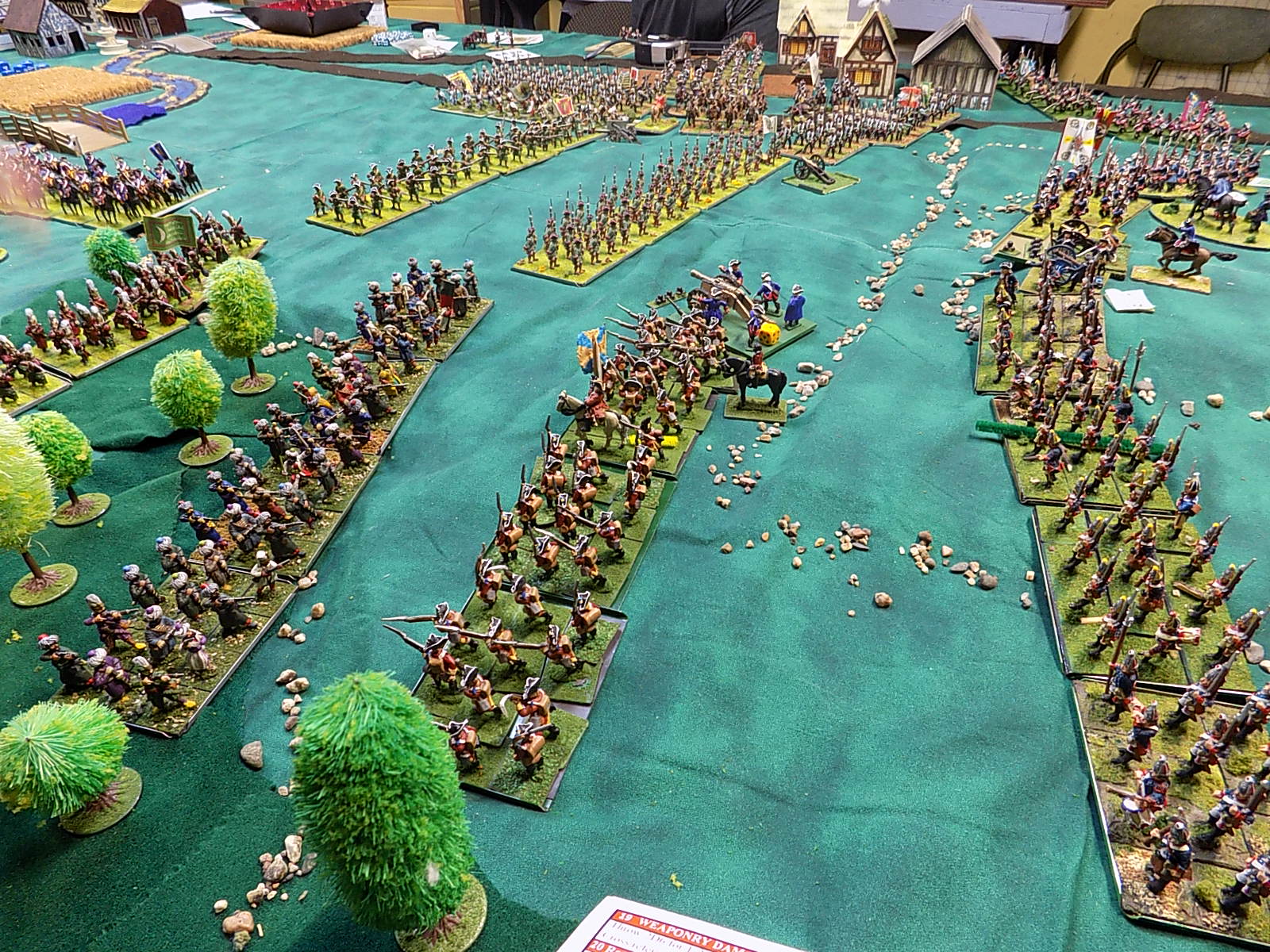
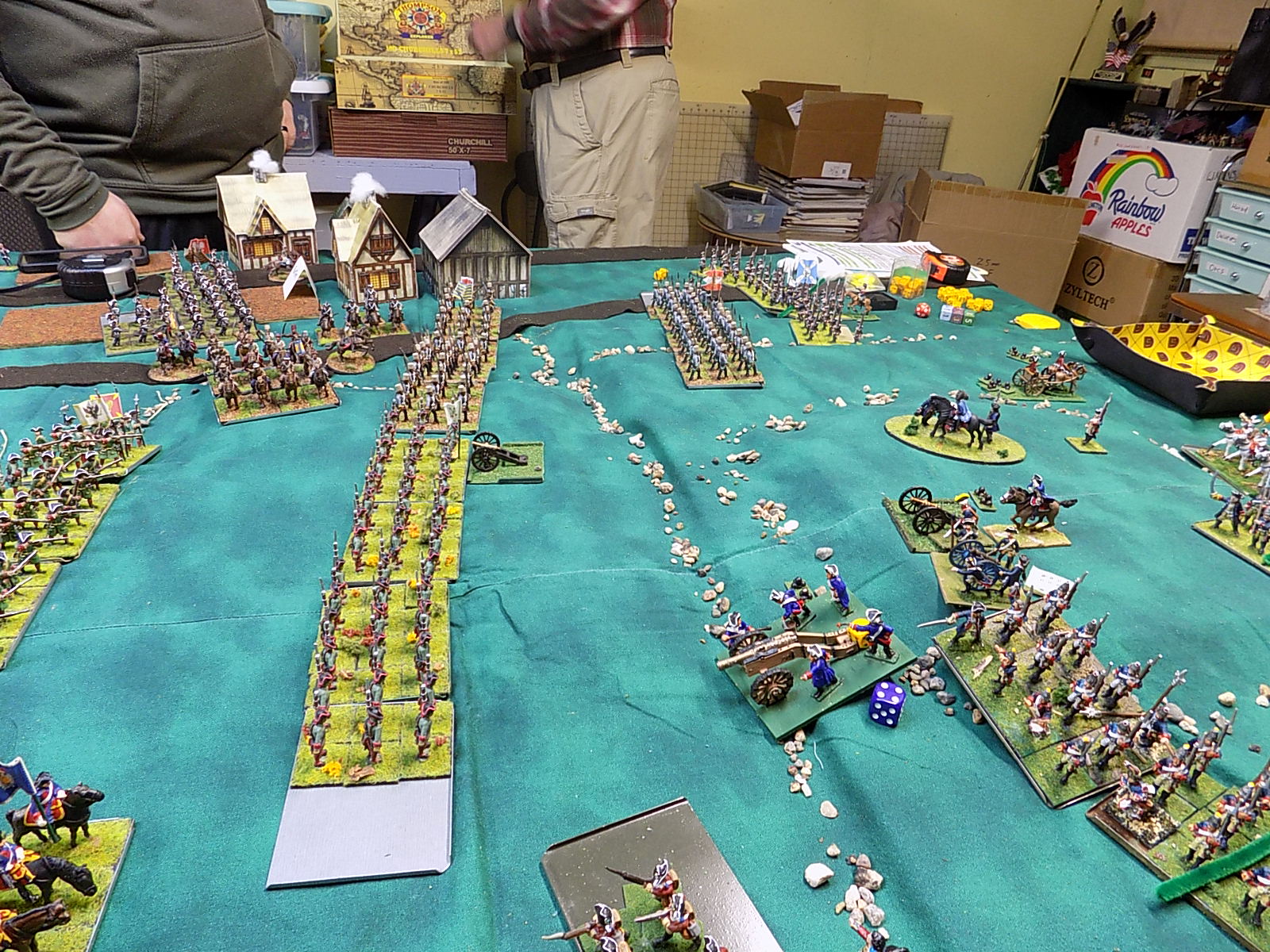
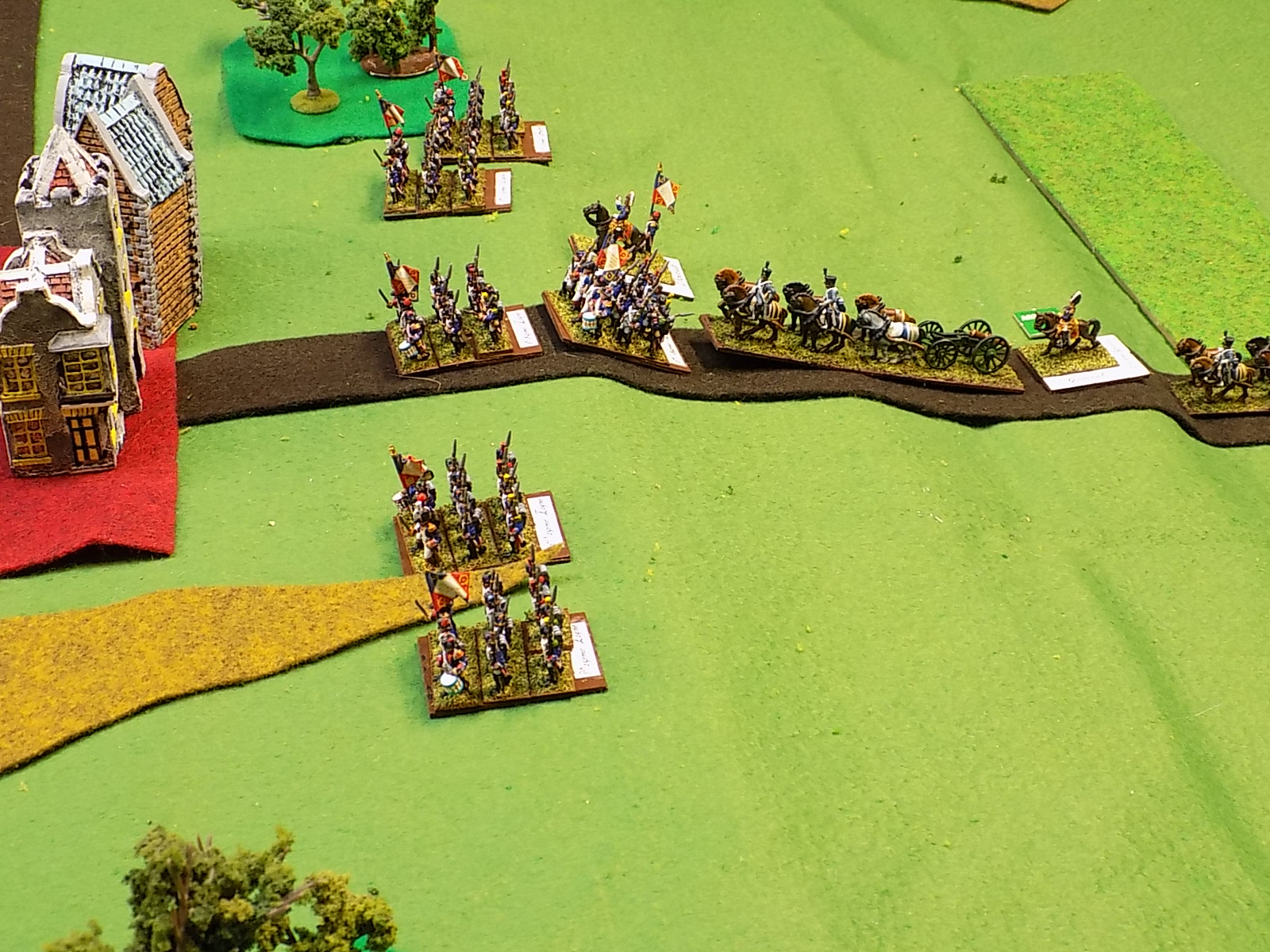
I played in a French and Indian War meeting engagement.  Bill and I had the French with three small line battalions, a smaller converged grenadier battalion, a good-sized group of miliciens Canadien and a war band of natives.  Four light guns rounded out our force.  We were faced by four larger British battalions, one of which were grenadiers, three guns of unknown weight and the ubiquitous Roger's Rangers.  Oh how I hate those little green men!  I had expected we would be playing Drums of War Along the Mohawk, Bill's rule set for the F&I period, but we used the more familiar Batailles de Ancien Regime (BAR).

As commander I hit upon the flawed plan to take the grenadiers, natives and milice with the lightest gun on a flanking maneuver.  The natives and milice, being open order types, could go through the woods and became engaged with the Rangers right away.  Our grenadiers, wanting to stay formed took the long route and ended up never being engaged. 

Again, I have no idea what happened to my pictures, but given the result it is perhaps better there is no record.  <grin>  While I had the pleasure of surrounding, meleeing and routing the Rangers, the British line in their best tradition went "hi-diddle-diddle, straight up the middle."  A combination of a joker in the hole, eight or more straight red cards and hot vs. cool dice we could not stand up to the onslaught.

Despite disappointing results, it was a great day.  Whether you call us Old Schoolers, old farts or just gentlemen, the games at Bill's are always characterized by good-natured kidding and active competition.
----------------------------------------------------------------------------------------------------------------------

Sunday my friend Bent Olson introduced me to SAGA.  Todd took a 6 point Irish "army" while I was given Normans.  For those like me who are unfamiliar with Saga it is a skirmish game in the spirit of the currently fashionable systems.  That is to say, vaguely historical with a lot of gamey flavor.  It is a competition game where much like Maurice or Flames of War there are national specialties or gimmicks.  You roll Saga dice every turn to determine what options you can use in the action phase.  Most are offensive though a few can have a defensive nature.  Combat is resolved in any order desired in terms of missile attacks, movement and melee so as a former tournament chess player I felt I had an advantage being able to visualize a "combination" to get to the position I wanted.  Whether such perfect coordination belongs in a game I'll leave for others to decide.  Meanwhile, the pictures I took speak for themselves.  Yeah, my camera worked Sunday.


In the end the combination of Norman archers and killer cavalry left the Irish broken and returning to their swamps.

All played on a 3x4' table in about three hours with LOTS of time taken explaining abstract concepts to the slow-to-understand, like me.  I'm sure that if I played again it would go much, much faster.

However, much like my exposure to Maurice I have a hard time reconciling the options on the battle-board with anything historic or realistic.  If it was fantasy and the Normans were Rohirrim, which is how I always saw them pre-movies, then fine, but as soon as you call it historical I have a problem.  I'll play it again if given the chance, but for now I'm not going out to purchase the spendy (IMHO) rules and high-gloss supplements.
 

Sunday, April 7, 2013

Seven Years War Association Convention - Part II

The second day of the Convention saw numbers to reportedly the highest total since 1994.  Certainly an encouraging thing.  After a good night's rest I was prepared to help the French finish the job against the East India Company and evict Britain from India once and for all.  To my surprise I found myself portraying the Compte d'Estaing in command.

One of the fun modifications to Tricorne was a series of event cards, one drawn for each side each turn.  Some were blank, some were good, some were bad.  Our first card had a shot ring out and the Indian Prince commanding our cavalry slumped over in his howdah, dead.  "It came from the Highlanders!" was shouted by the Prince's nephew as he dumped his uncle from the elephant.  A dice throw later and the entire mass of the new Prince's cavalry launched itself forward in search of vengeance.  They could also have milled about with morale -2 with other results in between.
The great siege cannons roared at Bungwash and the French/Indian left lurched forward in rambling masses of mostly unformed infantry.
In the middle the best infantry awaited developments as the Jesuits promised eternal rewards for those who fell in battle and I took a drink of water from Gunga Dink.

In other games getting underway we had an attempt to retake Quebec in 1760 using Batailles de Ancien Regimes by Jim Purky and Bill Protz.
And a 10mm game using Black Powder, the Battle of Dornzorf by Steve Verdolia.
The visually stunning naval game of Suffren vs. Hughes in the Bay of Bengal by Jeff Knudson.
A "what if" variation of Zorndorf by Todd Fisher using Revolution and Empire in 15mm.
And Iroquois Terror at skirmish level by Todd Kirshner.

Meanwhile, back at the jungle, the cavalry clash initially didn't go in our favor but numbers ended up telling.  On the left our mobs beat their mobs and the great cannons ran off the Sepoys they were facing. 
Surrounded and destroyed!

As if my mutual signal both sides began a general advance.  The Sepoy contingents clashed, a detachment of sailors drew the fire and ire of opposing Sepoys, and my blue-jacketed heroes to be moved forward to also draw the first fire of the Highlanders as the cavalry attempted to turn the Company flank.


Things appeared to generally going favorable for us despite some wretched morale tests by yours truly, when the random card was drawn.  The "Spirit of Riki-Tiki-Tavi" infected the unit closest to a Company opponent and an automatic charge occurred.  It of course fell to my blue heroes who, in my official report fell upon the Highlanders with such vigor that not even the famed claymore could halt them.  In reality in testing to stand, the Highlanders rolled a zero-something and disordered themselves.  Their fire stopped my heroes who had to fire a volley.  Because they were disordered the Scots had to test again for the casualty and routed away.
Elsewhere on the table things just collapsed for the Company men.  The next campaign game will either be for Madras, the last possession, or perhaps a French invasion of Senegal.  Alas, it may be without the Compte d'Estaing.  The last random card of the game said "French commander in chief felled by stray shot."  I don't know if I pulled through or not.

I went out for a sandwich with a friend, planning to play another game of Final Argument of Kings, this time in 25mm.  Alas, when I got back a sign-up sheet for Burkersdorf had appeared and it was full.  I made no ado of it and moved on, only to discover later that they had added players.  Drat!  On the other hand, I was quite fatigued from my long Spring Break and took a power nap in a chair.  :-)  It seemed like a couple of scheduled games didn't happen or I missed them.

I had a chance to get into another sailing game but decided to shop, visit and observe.  It again was impressive and dramatic.
The Battle of Burkersdorf mentioned above had some really impressive troops and terrain.  A segment of the battle, the Prussians were tasked with driving the Austrian artillery and limited supporting infantry from redoubts and a village.

At one point in the assault, not one, not two, but three Prussian battalions were sent tumbling back down the hill by the stout Austrian gunners and fusiliers.

The event was capped by a short meeting, award of the Legion of Honor to Jim Purky for continual dedication to promoting and enriching the hobby (congrats Jim!), and a talk by guest of honor Professor Christopher Duffy on the development of the division system.  Informative and amusing it was the perfect end to the day.  Professor Duffy was a real treat to meet and I got him to autograph his book that had the greatest impact on my understanding of the period.

This convention is unique in my experience since it was devoted to a specific century of warfare.  So everyone there was of a like mind and if this is one of your interests, I heartily recommend it.  Sorry if I've forgotten to mention anyone or anything.  It was a very full weekend.  All the pictures I took can be found in a Picassa album here.


Seven Years War Association Convention - Part I

I made it!  Years of trying or hoping spring break schedules would line up and they finally did.  So game listings and shopping list in hand I arrived, prepared to be impressed.  I was not disappointed.

The quality of the miniatures and terrain was generally amazing.  So much love and attention paid to detail really heightened the experience.  There was Sanderhausen in 15mm with Final Argument of Kings (I played in this one):
And Falkirk in 15mm by John Read with Age of Reason:
An AWI battle by Legion of Honor winner Jim Purky using Sons of Liberty:
and Action Near Radeburg with Ken Bunger and Jurgen Olk using Tricorne:
Things aren't as grim looking for the Austrians in the game above as it might appear.  Units that were hidden or otherwise out of view weren't put on the table immediately.

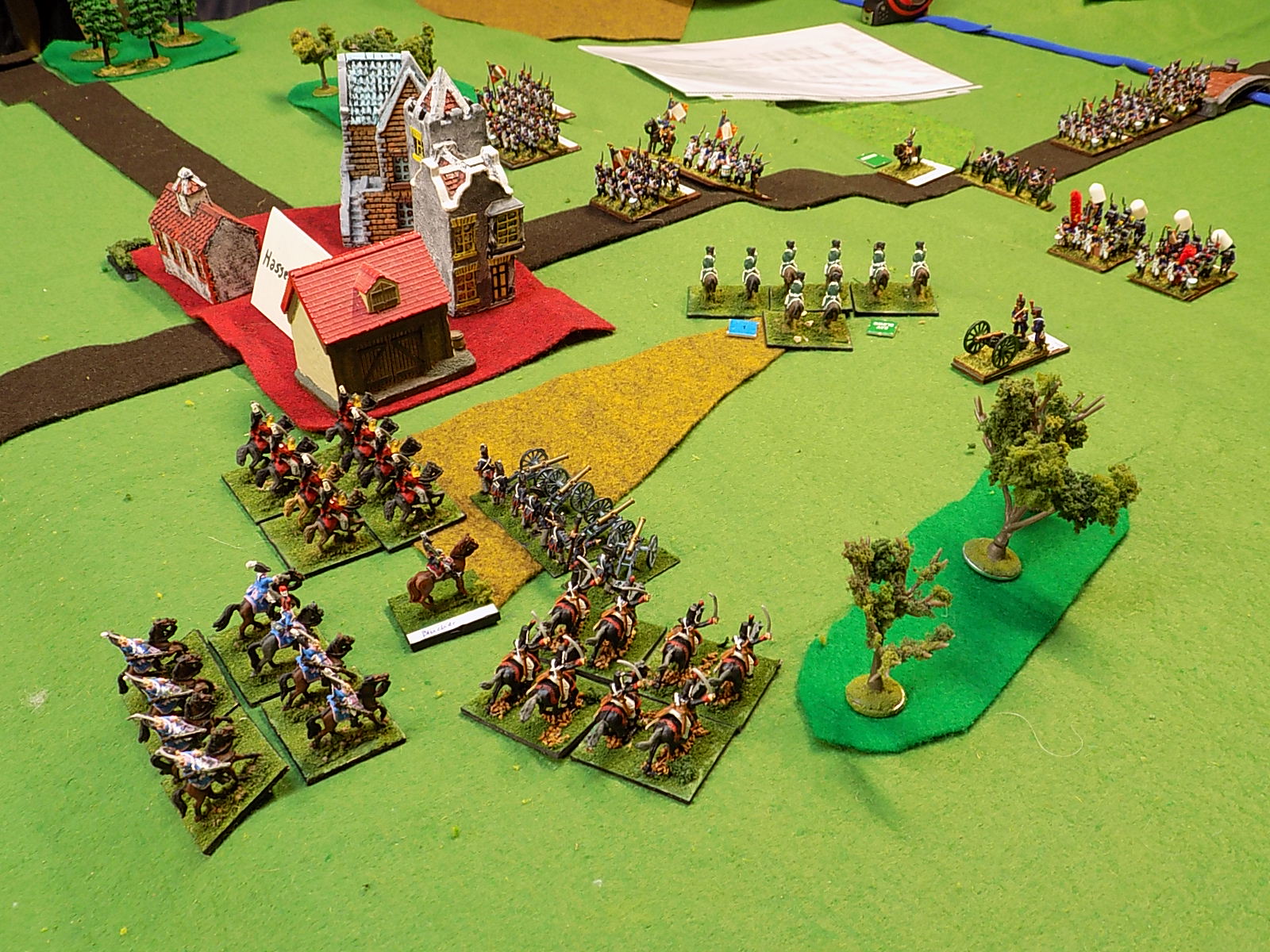
In my game, a carefully researched historic refight, it turned into a battle of maneuver.  The cavalry viciously clashed with the French triumphant.  In this case quantity won out over quality.  As a result the infantry on both sides were largely unengaged until the Hessians were backed up against a dense forest with an impassable river behind that. 
They beat the Parley and to prevent unnecessary effusion of blood, I took it upon myself as the cavalry commander to grant them honors and let them march off with a three hour head start.  They then set up this picture opportunity of them marching off:

Quality sellers were in attendance and I dropped cash with George Nafziger, RSM and another shop I regretfully forget the name.  Books, miniatures and accessories were in large quantities, in and out of the period.  Eureka had tons of gorgeous miniatures with them, but alas are a bit pricey for my teacher's budget.

Afternoon/Evening games were the Battle of Suckenplatz using With Drums Beating and 10mm figures which I seemingly didn't get a picture taken.  Prussians vs. Russians in 25mm by Jude Becker using Age of Reason:
A Konig Krieg 15mm and Last of the Mohicans skirmish game in 25mm that I apparently also failed to get pictures of.  We were supposed to play the Battle of Bungwash in India Friday night.  The tenth engagement in an on-going loose campaign for control of India, the French had won nine of ten battles.  Clive was sacked long ago and now the besieged have issued forth to drive off the "French" and their allies.  Alas, too many key players were eating or otherwise indisposed so the game master, Jurgen Olk made the executive decision to put it off to Saturday morning.  Unfortunate for me because that was already the time slot that had the most interesting games, but that was the decision.  In the meantime, here are some pictures of the pre-game set up.  Talk about a colorful period!
Bungwash besieged.
French siege train
French Sepoys and Indian leaders
Company Sepoys
My mob of unformed future heroes and accompanying rocketeers.

I'll post all the pictures to my Picassa account later and give you a link in my part II report.  As the saying goes, the best is yet to come.