Showing posts with label World War One - Naval. Show all posts

Wednesday, May 22, 2019

Grand Fleet vs. High Seas Fleet

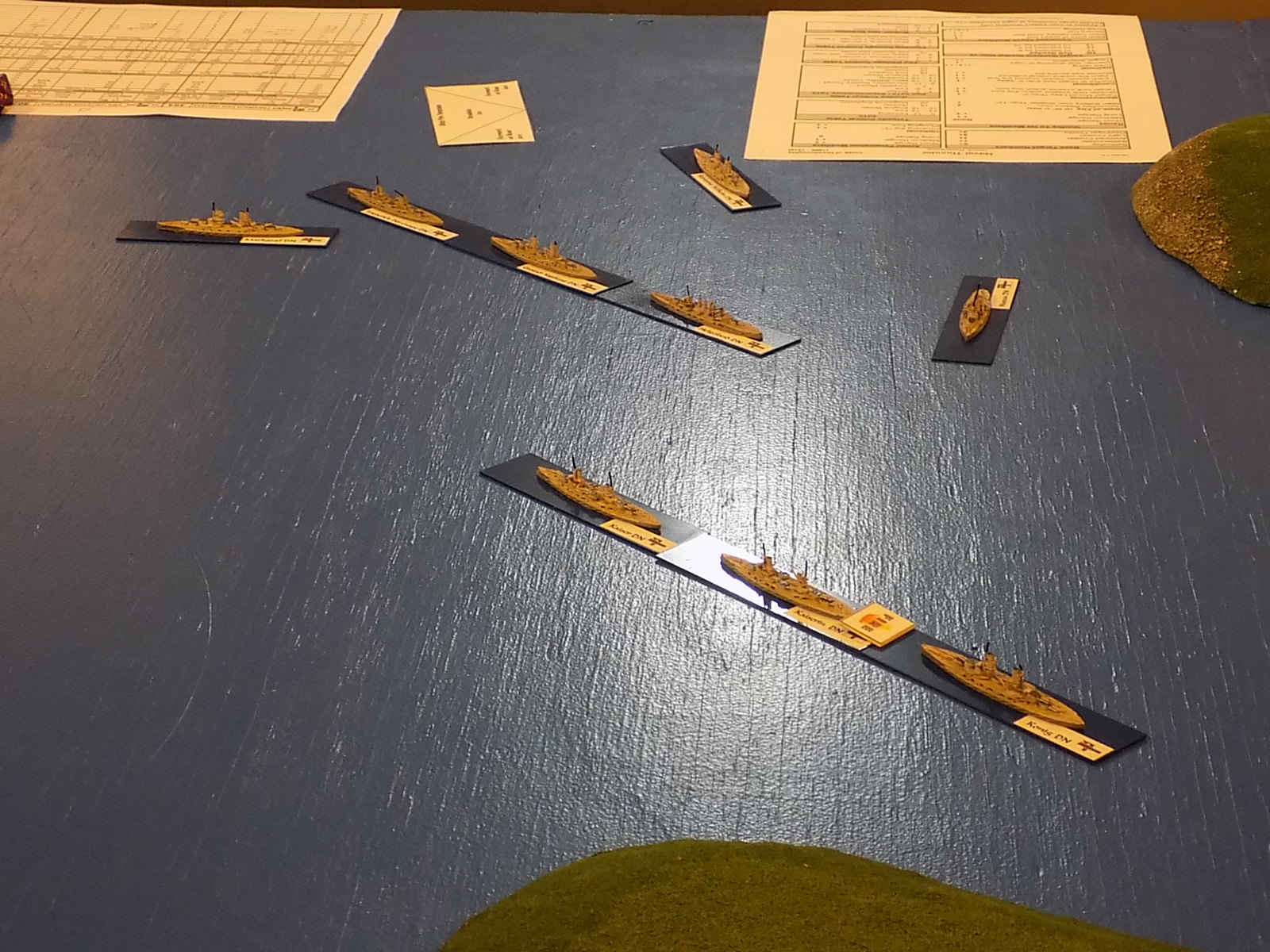
The Admiralty gathered May 10th to respond to the challenge at sea.  Rules are Naval Thunder: Clash of Dreadnaughts, scale is 1/2400, table is 12x6'.  Ten German dreadnaughts faced off against nine British.  Armor favored the Germans, gun range and number of big guns favored the British.  Which would be more important?

Two of the German squadrons navigate the, uh, islands of the Baltic.

The British are similarly sub-divided.

The Germans try to mass against one British element and use the
islands for cover while maneuvering.

The Grand Fleet begins to form line of battle.

Germans have concentrated, but while some maneuvered, others
were pounded.

Looks dangerously like a proper formation!

One ship breaks formation to make an end run.

Some German warships are already battered and dropping out
of line.

The British have not only had extra shots with their longer range,
but also get into a better range band first.

Surveying the table.  Note the satisfied looks.

Oil slicks begin to mark the table.  It's one to one now, but burning
and uncontrolled floods are piling up.

The Kaiserin limps away, only just managing to avoid burning out.

More oil slicks, all German.

German gunnery had not been ineffectual, a number of British ships had taken engine room hits reducing their speed, which would allow the rest of the Germans to escape lest pursuers be defeated in detail.  But the British shooting had been phenomenal at times and the German damage control rolls wretched.  A deserved win for the Grand Fleet, extending Admiral Jellicoe's career at sea a bit longer.

Saturday, May 27, 2017

Scuttled on the Skaggerak

The battle lines were drawn as the dreadnoughts converged on each other.  On one side, approaching from the west, came HMS Warspite, Barham, Malaya, Valiant, Revenge and Iron Duke.  Opposing them were SMS Baden, Bayern, Konig, Grosser Kurfurst, Kronprinz Wilhelm and Markgraf.

Rules are Naval Thunder: Clash of Dreadnoughts.  Optional rules in play are "Crossing the T" and "Cordite Flash."  The former gives the shooter extra chance of penetrating the armor and the latter makes the British (only) roll to see if they blow up when they take a main turret critical hit.  The game was a play-test of a planned convention game.

The Hochseeflotte approaches.

From the west in three columns are the British.

Warspite and Barham draw first blood while the Markgraf and
Kronprinz Wilhelm are still out of range.

The signal from Warspite to "Form line of battle to the north"
seemed to cause confusion.

However, the pummeling continued.

Attempts to form up continued to fail, so we just went independent.

HMS Malaya and Revenge begin to take a lot of hits from the
Baden and Bayern.
 Suddenly everyone had blink and cover their eyes as the Bayern disappeared in a massive explosion.  So swift was the result and disappearance of the ship that no record exists.

Ships were commonly double-upped on for firing.  Splash markers
indicate targeting.
 SMS Markgraf and Kronprinz Wilhelm succumbed to repeated hits and raging flooding.  The Valiant disappeared in a cordite explosion.  HMS Revenge sank after receiving seven critical hits at once.  SMS Grosser Kurfurst went down as the Iron Duke limped away with severe flooding.

Death ride of SMS Baden and Konig.
Torpedoes began to fly and secondary batteries went into overdrive as the ranges dropped.  A severe list on the Baden kept her from firing torpedoes and both the Baden and Konig went down in a blaze of glory.  However, the celebrating British still had to deal with damage control issues.  As the Iron Duke crept away from the battle scene her list increased till she turned turtle and was lost.  On the Warspite fires increased till the cheering German survivors in the water watched he go down.

So while the Admiralty will not be pleased with the loss of so many fine ships, the Kaiser will be even less pleased that his splendid ships will not be returning to Kiel.  In the real world, the game was completed in just under three hours, so a perfect convention game.


Saturday, January 14, 2017

Action in the Adriatic

At TundraCon III in Appleton, WI I ran a what-if scenario pitting the fleets of WWI Italy and Austro-Hungary against one another.  Naval Thunder: Clash of Dreadnoughts were the rules of choice, played (easily) on a 6x6' table with six players.

The Austro-Hungarian fleet was composed of the dreadnoughts Prinz Eugen, Viribus Unitis, Szent Istvan (flag) and Tegetthoff, supported by the pre-dreadnoughts Radetzky and Zrinyl.  The Kingdom of Italy was represented by the dreadnoughts Leonardo da Vinci, Dante Alighieri, Andrea Doria, Giulio Cesare and Caio Duilio (flag), supported by the armored cruisers San Marco and Pisa.

The A-H force was secretly required to have at least two columns, one of the pre-dreadnought and one (or more) of dreadnoughts, separated by at least 5000 yards.  The Italians were secretly required to come in line-abreast with the dreadnoughts.  Starting distance allowed for a turn or more of maneuver before firing commenced, being limited to 36" for the main guns on both sides.

A+H force chose to have three columns.

Approaching Italians.
Early on it was a contrast in planning vs. luck.  The Italians swung into line of battle on their second turn to allow full broadsides.  However, while they scored hits right away, they failed to penetrate the AH armor most of the time.  The AH force however kept in three groups and managed to mask the fire of parts of their main batteries.  Yet when they hit, penetrating the weaker Italian armor was easier.

Italian line of battle.

AH fleet seems to be fanning out, inviting destruction in detail.
The broadside differential, 56 AH vs. 65 12" guns, was partially mitigated by the stronger armor of the AH ships and bad luck on penetration rolls for the Italians.  Soon the Andrea Doria had lost two turrets, the Dante Alighieri had lost her fire control and flooding induced a severe list on the Giulio Cesare.

Chits indicate critical hits that have started fires, flooding, etc.
And then the proverbial "Golden BB" struck.  A rare penetrating hit on the Szent Istvan went all the way to magazine, causing her immediate destruction.  Since that was the flagship all the other AH ships had to make command checks, modified by damage taken to continue the fight.  Surprisingly, all five survivors carried on.

Disaster strikes the flagship.
As ships closed to sometimes medium range the hits began to pile up.  Sunk were the Dante Alighieri and Andrea Doria.  On the other side, a never controlled flood sank the Radetzky and the Tegetthoff succumbed to mass fire.  The final straw was when the Zrinyl took a rudder hit and would spend the rest of the game circling to the right.  The Prinz Eugen and Viribus Unitis decided to break off the action, leaving the Zrinyl to her fate.  On the other side the Giulio Cesare's speed had been reduce to 1" and the Caio Dulio to 3".  So they were happy to see the Austrians depart.

End game, just before the Radetzky and Tegetthoff sink.

In terms of points, the AH fleet lost 888 in the four ships (we presume the Radetzky would sink).  The Italians lost 516 in sunk ships and 129 for mission kills; total 645 points.  So a close and expensive victory for the Italians, but given the actual French and British support and the damage to the AH "fleet in being," things were going to go well in the Adriatic for the rest of the war.

GHQ graciously donated two gift certificates which we diced off for.  Hopefully they will help the fleets grow.  Everyone took adversity and good fortune with equal grace, a most enjoyable game to run.

Wednesday, May 13, 2015

Troubridge's Dilemma

Naval Thunder is a popular system with our group because it gives a quick game while offering a lot of "flavor" of the genre.  With just three players available I took it as an opportunity to fight a "what if" action from the first days of World War One. 

Historically the German battlecruiser Goeben and light cruiser Breslau sailed past two British battlecruisers just hours before Britain declared war on Germany.    A confused pursuit resulted in the pre-satellite days with no knowledge of whether she was headed for an Austro-Hungarian or Turkish port.  A squadron of British armored cruisers had the potential to intercept them near the mouth of Adriatic.  Battlecruisers were intended in part to kill armored cruisers so although there were four of them to the one battlecruiser Troubridge opted not to engage when he couldn't manage a night-time encounter.  While officially exonerated by a board of inquiry Troubridge never held a command at sea again.

Here we assume that a dawn engagement occurs.

SMS Goeben and her consort the Breslau attempt to reach Turkey.

Armored cruisers HMS Defence, Black Prince, Warrior and Duke of
Edinburgh boldly attempt to intercept.
The British squadron sighted the Goeben at a range of 31,000 yards on a converging course, well outside the range of their 9.2" guns, but also outside sighting range for the Germans.

Quick Reference Sheet with essential charts.

Sighting the Goeben first, they turn to close the range.  HMS
Defence is immediately hit and starts flooding.

Recognizing the Breslau cannot affect the action, the Germans
turn south effectively shielding the Breslau.

Goeben hits with her first salvo and continues to pound the cruisers.
Soon secondaries kick in as well.

The British break formation to attempt to sandwich the Goeben.
She is hit but so far her armor has not been penetrated.

A magazine explosion puts an end to HMS Warrior as the
Germans attempt to cut through the opening. The Goeben takes a torpedo
hit but the flooding is immediately controlled.

A second magazine explosion seals the deal as HMS Black Prince
goes up and the Germans escape.

With that the Goeben was able to escape to the east as a bridge hit was going to take the Duke in the wrong direction for a time.  Though down 32 of 90 points and with a speed reduced to 4 she would not be overhauled by the pursuing British battlecruisers.  The Breslau was also badly damaged with 10 of 18 flotation left, but the Defence had been hit so hard she could be finished off any time the Germans chose.  Had the Goeben speed been reduced to three, regardless of any other result, she would have been ruled a kill.

Done in an hour and a half and fought to a conclusion.  Naval Thunder handles small and large actions equally well.

Sunday, July 7, 2013

Battle-cruiser Action in the North Sea - 1916

With visibility at 20,000 yards and a moderate sea state light cruisers and their attendant squadrons of torpedo boats and destroyers had scattered to scout other areas as the British and German battle-cruisers suddenly found each other.  (Translation: with only four players and two of them new with the rules I elected to just use the capital ships.)

Spotting the enemy on converging courses the Germans were pleased that the British did not take advantage of their greater range, but in the best Nelsonian tradition closed quickly.  At the start 1st Battle-cruiser squadron; Lion, Tiger, Queen Mary and Princess Royal were slightly behind and paralleling 2nd BC squadron; Indefatigable and New Zealand.  Beatty order the Lion to join with 2nd BC squadron to balance the forces.  (Translation: two British players, each with three ships.)  Meanwhile 1st Scouting Group had Derflinn=ger, Lutzow, Seydlitz, Moltke and von der Tann in one continuous line.  ("Hipper" controlled the two big BCs while I had the 3 smaller ones.)


The first turn all the German ships except von der Tann who was out of range by accident fired on the Indefatigable.  With the over-concentration there were a lot of splashes but no hits.  The British however scored on penetrating hit on the bridge of the Derflinger, killed Hipper and locked them on the steady course for at least two turns.


Retribution was coming fast though.  On turn two the Moltke and von der Tann concentrated on the Indefatigable and the Seydlitz on the New Zealand, while the heavy BCs engaged the Tiger.  A pair of hits on the Indie lead to a magazine explosion that stunned all.  (Translation: we were using the "Cordite" rule to see how it played.  So any penetrating main turret hit gave the possibility of a magazine explosion.)  All the other ships except von der Tann took damaging hits, though none as serious.


Turn three had Derflinger and Lutzow continuing to sail away while the other three BCs wondered what was afoot?  Moltke and von der Tann continued their teamwork taking on New Zealand while the Seydlitz shifted fire to the Tiger.  Seydlitz was rewarded by a flooding critical that induced a severe list on Tiger.  In what was turning into two combats, the Derflinger had the attention of two excellent BCs while the Lutzow was taking love from the Princess Royal.  Again, a mix of penetrating and non-penetrating hits were scored as the range dropped to medium for both sides.


Turn four was a bad one for the British.  Moltke and von der Tann got their second magazine kill of the day as the New Zealand went up in a fireball.  Beatty was heard to say, "there seems to be something wrong..." glub-glub; as the damage control parties, forgetting which side had the list, executed counter-flooding operations on the same side as the list and the Tiger turned turtle and sank.  (Translation: during the damage control phase the owning player rolled another "10" on a d10 which capsized the Tiger.)


However, things had not gone solely the German way.  Moltke was lashed with fire by the New Zealand before going up and suffered both a severe list result but also and engine room hit.  Her speed reduced to "3" she was ordered out of the line.


At this point with a knife fight in progress at short range for some ships and one player out of ships we faced a crisis.  So appearing like the cavalry two of Evan-Thomas' super-dreadnoughts appeared at table edge.  Those German ships that could turn away did so and for four more turns we had a running fight.  Thankfully the gunnery aboard the Queen Elizabeth and Malaya (I know, but they came to hand) was poor.  Still, when we quite the Moltke had joined the others by turning turtle before damage control could eliminate the flooding.  Derflinger was not long for the surface and while the original British BCs all had a little to a lot of damage only the High Seas Fleet could save the German battle-cruisers. 


Satisfied with the blood-letting and game we elected to quit. 

Rules were "Clash of Dreadnoughts" from the Naval Thunder family.  Even with explanation time for the new players we finished in less than three hours.  The game system is such that players needed no help from me after two or three turns except for looking us critical hits.  I'm very fond of the game in that it hits a nice balance between playability and detail to flavor the games.