Thursday, September 6, 2012

Figure Bonanza

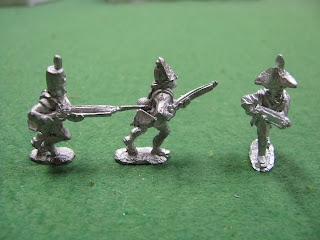
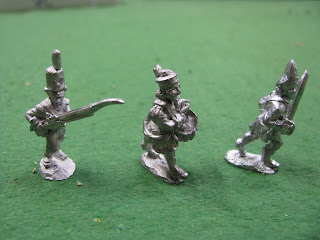
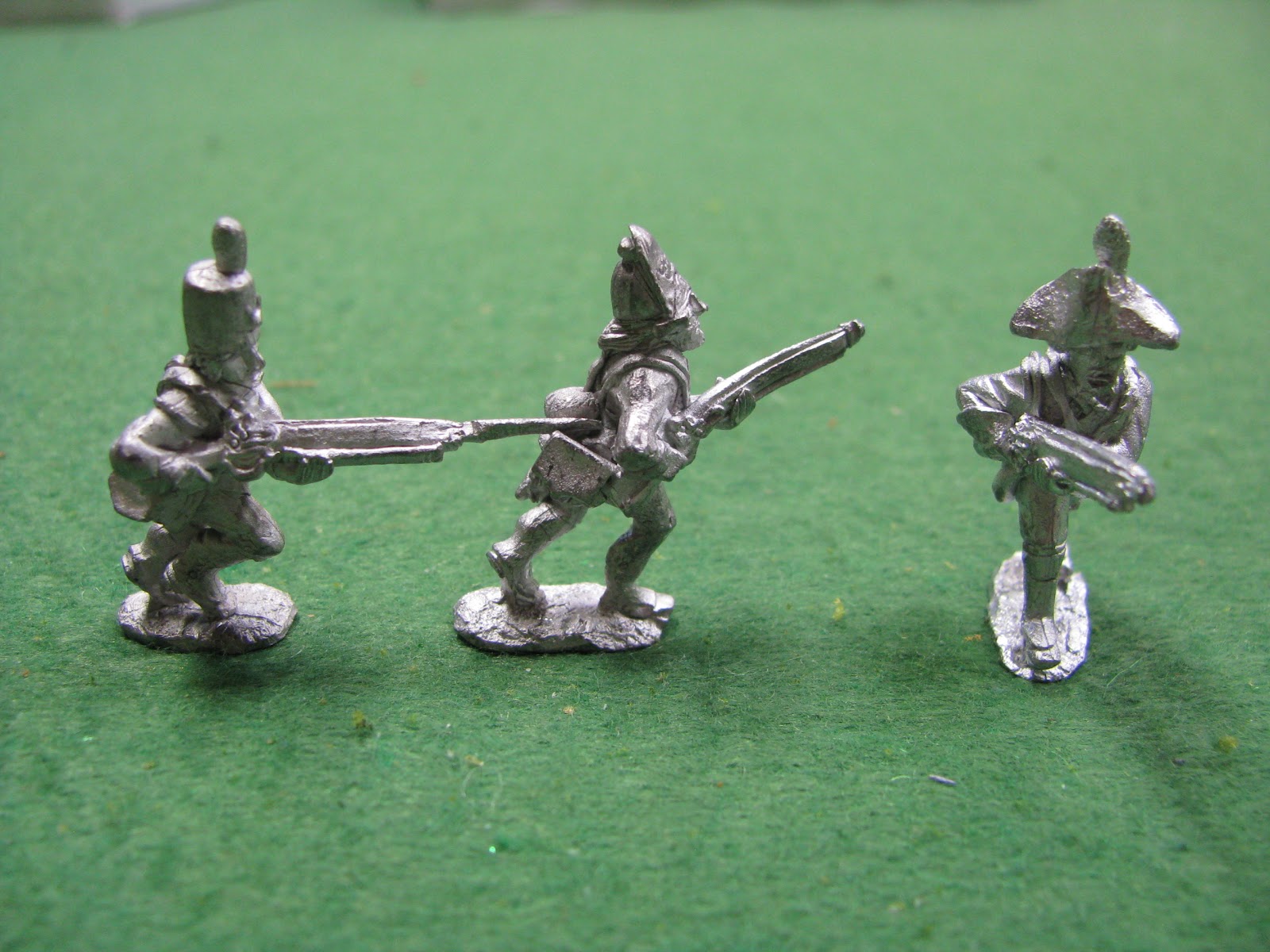
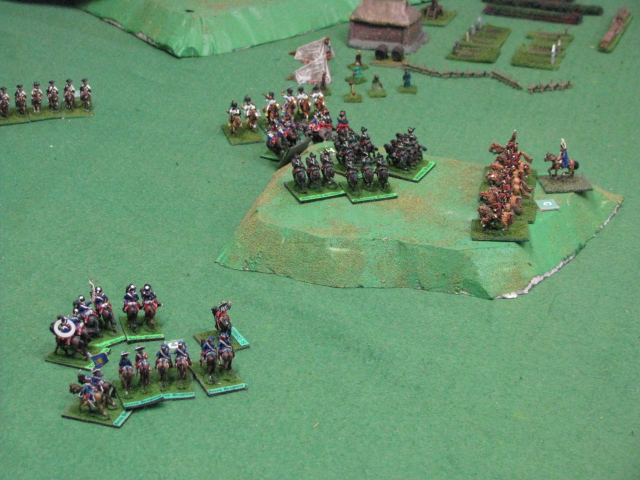
Our gaming group managed a huge haul off of eBay recently for AWI and F&I figures.  Unfortunately they aren't mainstream figures apparently because we are drawing a blank.  They run from tiny 25s (Musket Miniatures) to husky, robust types.  Some sample pictures are:


I think we can rule out Foundry, Front Rank and Redoubt for the first three pics.  They have tags like W66 on the bases.  The fourth picture of much smaller figures are AIF type tags, and the last picture has figures with no help at all but are more traditionally sized.

I've posted on The Miniatures Page as well, so hopefully we can get some direction to guide us in sorting out the stash.  We got some 2500 figures for our group.  Thanks!


Monday, August 20, 2012

Guns of the Mohicans

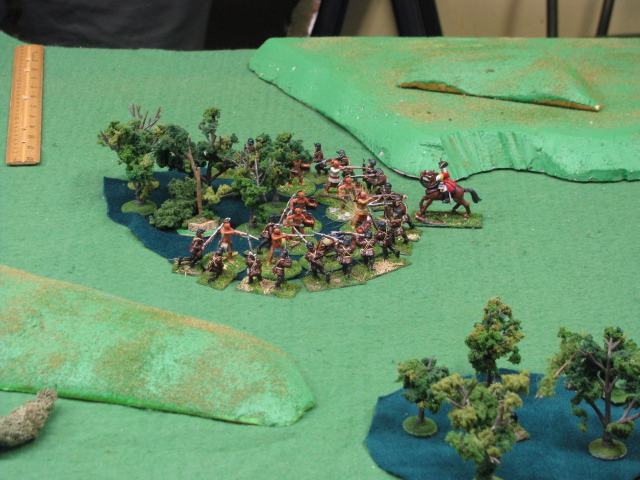
The advance guard of General Sydney Smythe-N-Jones moved through the wooded countryside, spotted with rolling hills and the occasional cut brook.  Ahead lay the main village of the natives allied with the damnable French.  Something that along with the small French settlement would be eradicated prior to the army moving on to the main French fort (TBA).

Colonel Locksley had a fine force at his command.  Elements of Lord Howe's 80th Lights, the provincial Ranging Company, two weak companies of grenadiers, half battalions of the 28th and 43rd RoF and Bagley's Provincials.  A galloper gun or two would have been nice, but they were with the main column, perhaps half a day behind.


The lights were deployed on either wing and to the rear to prevent any unpleasant surprises from the wily French or Indians.  Action was quickly gained as the 80th swept around a wood that showed movement and discovered a warband of Indians.  Thinking their superior numbers would quickly overwhelm the natives they charged home and promptly lost the melee.  The rest of the column advanced but slowly, wanting to have flanks secured before pushing on.


The rangers on the left evicted another warband, though then spotted Coureur de Bois filtering down via a sunken stream.  They faced them off as the 80th went in again, this time with a mounted officer to inspire them.


Only to be defeated again and the officer carried from the field severely wounded.  (He survived.)  The third time proved to be the charm and the 80th carried the woods and sent the remaining members of the warband scurrying for home.


Meanwhile a large group of Canadian milicien with a regular officer took up a blocking position.  Two companies of troopes des colonies (aka. "Marines") were swiftly marching up.  Other small warbands steadied themselves for the coming advance.  The Coureur de Bois were overwhelmed and taken prisoner.


On the right the 43rd and the Provincials deployed into line to drive off the Indian skirmishers.  The remnants of the 80th, who had suffered greatly in the three melees, protected their flank.


The Canadians, seeing the grenadiers and 28th deploying thought the better of standing, and behind of screen of other militia moved back to join up with the colonial regulars at the big surprise, a formidable redoubt blocking the glorified game trail serving as a road.

Not at all sporting, the British attempted to charge the skirmishers, thinking to sweep them aside and hit the rear of the militia column. But in a confusion of order and counter-order, the normally steady infantry failed to charge. A missed opportunity.


A firefight broke out between la Marine and the two British units which did not favor the French, and then was followed by a charge against the disordered foes that succeeded.  Numbers and the martial quality of the grenadiers prevailed and the French were sent packing.


Leaving the indignant French commander in British hands.  The militia and remaining natives, seeing the ever flanking attempts by the 80th and Rangers taking place, decided to depart post-haste.  There is always another day.


Rules used were Guns of Liberty with the Guns of the Mohicans variant.  The British had a slight numeric advantage (88 castings to 80) and a noticeable qualitative edge, unless you were fighting Indians in the woods.  The British had to completely deploy first and then the French since we figured they were being watched ever since they left home.  Casualties have been noted and a follow-up game will take place in a month as the British attempt to finish dismantling the native village and settlement. 

A most enjoyable diversion from our usual game types and a chance for me to use part of my significant collection of 25mm figures.  Thanks to all and just wait till next time!


Friday, August 17, 2012

1805: Austerlitz by Robert Goetz

I recently completed a new book on an old topic that I very much enjoyed.  1805: Austerlitz by Robert Goetz.  Greenhill Books of London, 2005.  ISBN 1-85367-644-6.


At 306 pages of text, pictures and maps plus the appendices, it is a serious read.  Being a strong Napoleonic history aficionado, I jumped at it as soon as I saw the detailed maps and order of battle. 

Over the last 200 years a great deal has been written about the destruction of the Third Coalition, much of it contradictory or at least in disagreement on details.  Mr. Goetz has taken the trouble to go through and analyze the various accounts to arrive at a "most likely" conclusion.  Since it is backed up with evidence, it has high credibility with me.  The maps are particularly interesting because in most cases you can follow the path of a battalion or regiment throughout the battle.  This is no mean accomplishment on his part. 

While the battle is usually looked upon as a foregone conclusion, much like Trafalgar, but Mr. Goetz shows how hard the Russians and Austrians fought, giving them full credit for individual courage and skill.  Where he concludes the battle was won was in the planning rooms and in the minds of key leaders who did or did not react to the changing tempo of the battle.  A fair conclusion in my humble opinion. 

On the downside, if you do not have an abiding passion for things Napoleonic or of Austerlitz, it will be a dry read.  Though it is full of anecdotes from memoirs and such, the style of delivery isn't as exciting as the battle itself.  The wealth of data, which I ate up with gusto, may well put off other readers. 

In the end I learned a great deal about the battle that I only had a vague idea about before and have a renewed interest in gaming some elements of the battle, particularly the northern sector between Lannes and Bagration.  A chance to pit two charismatic leaders against each other.  Of course, the fact that I participated in the 200th anniversary reenactment just enhances my interest.

Serious work on snow and ice

Definitely canister range

The Santon


Saturday, August 4, 2012

Paper Boats

I have often in the past sung the praises of the Dave Graffam paper building models.  blog post  Now, in an effort to increase my water-borne options I assembled his Patrol Boat.  As with most of the PDF products, you have a choice of "layers" to vary things up.  I've scratch-built several small craft and longboats before blog entry but this promised to be easier.  So, below you can see my efforts, mixed in with some 25/28mm figures by assorted manufacturers.  By scaling the printing you can make them much smaller.  I used foam core board for the deck, but just common cardboard like you would find on the back of a pad of paper for the rest.  It came with a square mast that you could form but I preferred the dowel and base so it would be removed as needed.  The crate pictured below is one of three that come with the PDF.

Comments or suggestions welcomed, click the pictures to enlarge please.

Approaching shore where smugglers await

More emerge from below-decks

A scratch-built longboat on the right

I like the details and dingy sail
Keep an eye on your purse here


Monday, July 30, 2012

3rd Battle

From the weekend of July 20-22.  We had already played Maurice and Batailles des Ancien Regimes, and now we were introducing the hometown favorite Final Argument of Kings to a guest.  The game called for an expected 33 battalions of Hanoverians, Brunswickers and Hessians to take on a French/Allied force.  As such, I put out 24 battalions of French, German, Irish or Swiss; four battalions of Bavarians, and four battalions of Saxons.  We were fighting for possession of a valley, so high(er) ground was on either flank.  Cavalry was roughly equal with quality on the Hanoverian side, numbers with the French.
French center and right
French left and their opposites.  All the cavalry was here.


From the French left-center looking inward

After a couple of moves I started to count noses.  The Hanoverian army looked a bit sparse.  As it turns out, a column of ten battalions and some horse took a wrong turn at Albuquerque and didn't show up.  The Hanoverian commander didn't inform me so the French/Allied army sported a significant numeric edge and now the onus to attack and drive them from the field.

Cavalry results, with disordered regiments evident

Swiss charging

Swiss winning

Attacking with supporting regiments the weaker French cavalry enjoyed early successes.  So much so that when the odds caught up they had still eliminated the Hanoverian cavalry as a fighting force.
Elsewhere the new player decided the best way to see how the system works is to test it.  So he attacked, and attacked, and attacked.  Fortune favors the brave the the Hanoverian left-center was decisively ruptured.

Forward the Wild Geese!

The French allies on the left push forward

The game wrapped at three in the afternoon.  Although the Hanoverian commander on their left had skillfully prepared a counter-stroke, there was little they could do.  With the edge in numbers the French enjoyed it was not a surprising result, but it was an enjoyable game as tactics continue to improve and more importantly, a convert was made to Final Argument of Kings as we continue to play-test the 2nd edition.  My thanks to the good-natured players.


Tuesday, July 24, 2012

Second Battle

Battle number two of the action-packed weekend was the high-light.  Batailles des Ancien Regimes (BAR) at the home of the author, Bill Protz.  The classic "big battalion" game, which lived up to the hype on a 26' table that with the walkways had a depth of around 11 feet.  The back tables are considered in play, which as you will see is an important point.

As our Seven Years War campaign winds down (we suspect a peace treaty next year), the battle represents the last great effort in the east.  Forces of Russia and my Litharus imagi-nation joined to battle the Teutonic aggressors in East Prussia.  While each side sought clear victory, most important (we were told) was to maintain a presence in East Prussia for bargaining position at peacetime. 

For game mechanics the table was divided by a passable river but each side played at their own speed with their own deck of cards to determine who moved first and fired first.  Thirteen players squared off against each other.  We'll start with the Russian/Litharusian right.  Click to enlarge pictures.

Most of the Russian right

Pandours into the woods, where they were effective

Taras Schvenko prepares his Cossacks and Hussars

Our plan was to stand pat and receive the first Germanian onslaught and counter their moves, hopefully maintaining a strong reserve for a decisive win.  The center was deliberately left weak in the hope they would be drawn to it.  Solid forces of infantry and a heavy position battery was on the right with the ubiquitous Cossacks.  Nearby were dragoons and horse grenadiers on the back table. 

Also on the back table was all four of our grenadier battalions in one brigade, more or less centered.  Spanning the river and on the left were two more brigades of infantry, another position battery, and on the back table eleven squadrons of heavy cavalry.  A total of 17 infantry battalions, five of which were under-strength.

Looking towards the Russian left

Feld-Marschal Earl looking optimistic

And why not with a reserve like this?

The Prussians had "roughly" (our spies weren't totally effective) fifteen battalions of guards, grenadiers, elites, jägers and the occasional ordinary musketeer unit.  Fifteen or sixteen heavy cavalry squadrons and five dragoon squadrons.  Two position batteries and an appropriate number of brigade batteries rounded things out.

The battle opened with the Prussians advancing boldly on the Russian right and very methodically on the left.  General Ouromov
was left to consider his options.  Attack on the right where the Prussians were weaker and attempt to quickly defeat it; attack on the left where the main thrust was clearly threatened, or await developments.  He opted for the last named.  It was feared that if over-whelming force went into the Russian right the Prussians would just pull back, trading space for time and the victory would elude him.

On the right Prussian dragoons advanced confidently against the lowly Cossacks, expecting that they would not stand.  An infantry battalion contemptuously wheeled against the Pandours in the woods, as if daring the Cossacks to charge.  Meanwhile the other infantry against the Russian right boldly advanced, attempting to hit the weak brigade in the center.

The Prussian advance on the right, jägers in open order distant

So as the Prussians advanced General Makolondra skillfully wheeled on battalion down the tall hill to enfilade their line, while advancing a second line battalion to fill the gap and protect them. And for the Cossacks? Taras Schvenko had the first squadron charge and temporarily rout the impudent Prussian battalion. The second squadron saw off a dragoon squadron and then locked in combat with another.

The counter-stroke begins

Cossacks mix it up as broken foes retire

Soon, with helpful fire from the Pandours, who chipped away at anyone within range, all three dragoon squadrons were fleeing.  Only one defiant and triumphant Cossack squadron remained, but with the unengaged hussars represented the only fighting cavalry on the right.

On the Russian left things got hairy quickly.  The lockstep marching Prussians advanced strongly everywhere and attempted to flank the far left of the Russian line.  Seeing this General Ouromov got the grenadiers moving and notified, via his chief of staff Brent Olso-Neevabeech, the heavy cavalry to engage.

The far left with position batteries firing and flank marches moving

A thin red line (summer uniforms) vs. the Prussian masses

Grenadiers begin to move, blocked by friendly cavalry

A great charge is prepared

A confused series of cavalry melees ensued, with the heavy Prussian gunners driven from their guns and some squadrons routed off, but the Prussians continued to make slow progress. 

On the right, the arrival of Russian dragoons coupled with the galling fire from the Pandours and advance of the line left the Prussians with little recourse but to pull back.  What surprised everyone was the extent of the pull-back.  After 3 1/2 hours play (minus lunch) the Russians found themselves in possession of the field on the right and the Prussians heading for the hills (literally). 

Prussians on our right have left the field

The new line faces a daunting task

Not much better looking here

In the next two hours the cavalry melees waxed to and fro with the Russian forces generally getting the short end of the stick.  Between the infantry the cards all seemed to favor the Prussians.  At one point there were eight black cards (to match the depth of their hearts) and two jokers in a row.  Jokers in BAR allow you to "trump" a card and allow your side to first or move first.  In fairness however, the cards had been very pro-Russia on the right flank.

A fierce melee, but always another Prussian squadron to feed in

Facing off on the back table

Closing stages, horse dragoons prepare to charge


The Prussians penetrated to the back table on the left but were facing off against a grenadier battalion.  On the main table some remnant units were coming back and the Prussian cavalry, although victorious was dangerously weakened.  Two charges by horse grenadiers won two melees and routed a Prussian unit but it was just a temporary set-back.  At the conclusion of the game (turn in progress at 4:30) the right had swept the Prussians away by 2:30 and were still contesting the left.  Unfortunately no units came over to the left where even a single battalion might have decided the issue for the Russian/Litharusian army early. 

So since our stated objective was maintaining a presence in East Prussia we write to Grand Duke Orzepovski of Litharus and the Tsarina announcing a great victory.  That's my story and I'm sticking to it.  My thanks to John Makolondra, John Beck, Don Deutschmann, Todd "Taras Schvenko" Prochniak, Brent "Chief of Staff" Olson, and Bill "Cavalier" Protz for fiercely contesting the field.

And a tip 'o the three cornered hat to the Prussians: Jim Purky, Randy Frye, Curt Benson, Earl Kyle, Todd Barta and Keith Leidy as gentleman opponents and valiant foes.