Friday, July 22, 2016

French/Allied Napoleonic Pass in Review

Prompting from a friend got our group wondering just how many Napoleonics we had painted for Empire and what they would look like at together on one table.  Well, 6,300 miniatures later we had the answer.  Below you will see pictures of two groups of Republican French, several from the Peninsula War, a few from the 1809 campaign with Austria, and one (la Garde) from Waterloo.  With a covey of Marechals fluttering about Napoleon, it made for quite the spectacle on a 16' table.  Click to big-up the pictures.

Republicans on the right, with Peninsula veterans and Saxons onward.

The early French groups are based on the historic OBs for Novi and Marengo.  Which of course prompted one of our group to paint up Suvarov's Russians.

The 1815 Imperial Guard is on the left and front right, backed by
Suchet's III Corps from Spain in 1810.

Surprisingly, among our five players contributing figures, we only had two duplicate formations, the 1er Reserve Cavalrie Corps from 1809.  But who doesn't want Carabiniers in bearskins?

Ney's VI Corps from Spain and Oudinot's II Corps from the 1809
campaign against Austrian, Poles and some generic French.

We decided to include French allies, with Poles, Italians, Saxons, Bavarians, Hessians, among others present.  Their contributions to the early French victories not to be forgotten.


Among my collection is a gathering of the French Marechals.  Note l'Empereur and his entourage, Massena in his carriage, and a host of others.  Some not pictured are with their corps.

 
Yes, per Empire the guns should be over-crewed, but hey...


I painted these in the 80s an early 90s and they have served me well.


A grand view of the center and right table.

We weren't even set up completely yet and the army stretches onward.

Next up, the Allies.  Russians and Prussians and Austrians, oh my!  Prepare for an even more cluttered table.


Monday, July 11, 2016

Battle on the Mississippi 2016.3 - Flames of War

Saturday we had a small Flames of War, mid-war tournament at Deaf Ear Records in la Crosse, WI.  After last minute drop-outs we had ten players competing for some nice trophies, plaques and BF items.  I took my Italian Bersaglieri company, based on the AS42 reorganization where they broke up the weapons platoons and mixed them with the infantry.  So I had two platoons of four Bersalieri stands, two 47mm ATGs, two HMGs and one platoon with a Solothorn ATR and the other with two 20mm AAG.  Rated "elite" they are an "always defend" company.  I added a Bersaglieri platoon of 8cm mortars, a "Demolisher" (engineers) platoon, a Recce platoon of three AB41s, a platoon of Semovente assault guns, a battery of 100mm guns and, the key to my survival, a pair of 88s with extra crew.  The Germans handed over a few to the Ariete Division in '42 so they could appear on my list.  A total of 1700 points after adding the sticky bombs to the infantry.

Chuck Hiner and crew make it a point of pride to set up some really sharp tables with at least one that goes with each army entered.  So I could be confident that I'd play on the desert table first round.  With good fields of fire for my 88s I felt optimistic.  Click the pictures to "big-up."

Table as expected but facing a Soviet tank company built around
T-34s.  Mission was Breakthrough (Mobile Battle).

Only the 88s could realistically hurt the T-34s frontally, but the
100mm guns killed a couple.

Lovely terrain and models.  Tom made a bold rush but in  the end
it was a 5-2 win for me.
After a lunch break I was paired with "horde of Stuarts."  A lucky pairing since my anti-tank guns could affect them frontally.  Mission was Fighting Withdrawal but with 8 platoons I had some leeway to pull without massively compromising my fighting ability.  Jason was properly aggressive, used smoke to mask one of my 88s and hit both flanks.  However a combination of my hot dice and his frigid dice doomed his attack.  He later deservedly won the Best Sportsmanship prize.

M3 Lees advance in the middle while Stuarts and armored infantry
work the flank.

With the 40" range the 88s can be way back.  Demolishers in the
middle and Bersaglieri on my left.
At one point some American M8 assault guns worked around and engaged my 100mm guns in a direct fire exchange, but that didn't work out for them.  In the end, a 6-1 win.

Last round I got the worst possible table, a burnt out city.  With the 88s needing to stay together and extremely limited "reach out and touch" potential, I felt doomed when the Soviet KV-1s hit the table.  Fatigue also showed since I made some poor deployments and wasn't even keeping track of when his armor went into play.  Otherwise, it was an all infantry force which ended up being my salvation.  Mission was Free-For-All.

So here are my AB41s and Semoventes, facing the KVs they
can't kill frontally or to the flank.

On the left are my 88s, which did manage to kill some stands
but never had a shot at the armor.
Because of the sheer number of stands Jim had to move each turn we ran out of time.  I destroyed a platoon of guns and lost nothing, out of total luck, so it was a 2-1 tie in my favor.  I had the great good fortune of playing three really nice guys, never needing to deal with "that guy" that tournaments can bring out.
 
First place went to a Finnish player.  I got second and Best Axis General, while Jim got Best Allied Player.  It was nice to see two of the top spots go to "minor" armies.  Besides the trophy picture below I chose the scenario/campaign book "Battles in Italy," which seemed somehow appropriate.


Friday, July 1, 2016

Some Summer Reading

This past June I made the decision that forty years in education was quite enough thank you and retired from my middle school position.  Among the many gratifying outpourings of appreciation came a great many Amazon.com gift cards from my students.  So with time no longer a likely deterrent I've been picking up books to pursue my love of reading and history.  Presented for your edification, my initial summer reading list.  Remember to click the pic to enlarge.

First up an account of the Luftwaffe's last gasp attack on New Year's Day, 1945.  Full of planning details and anecdotal bits from both sides of the lines.  The Stackpole series has been very good to me over the years.  Highly recommended.

Next is what I'd classify as one of the final actions of the French and Indian War, rather than the Seven Years War.  All the campaigns in the Caribbean and North America seem somehow interrelated.  I see quite a lot of gaming potential to be found in this one and a chance to use my Spanish figures.

If I could only do one period of gaming for the rest of my life, it would have to be Napoleonics, and having grown up reading Chandler, Oman and Napier the Peninsular War is right near the top.  Converting historic actions to the tabletop is often problematic, so since it's been done, why reinvent the wheel?  Large collections of figures await.

Now this one has some serious eye candy.  Chockablock full of color pictures of some of the most magnificent figures and scenery imaginable, plus history of the hobby and a complete set of rules.  I anticipate hours spent savoring it while perhaps sipping cognac.

This battle has always fascinated me.  So much so that I've played it out on the game table at least three times.  This book will likely inspire a fourth attempt.

The last one was more of a "complete the collection" purchase.  I have the related series on the naval battles during the Republic and Empire plus the War of 1812 and frankly love them.  So this seemed like a no-brainer.  The fact I could get it at an "antique store" for just 15USD was gravy.

Now mind you I have a great many more books that have been piling up waiting for that mythical point when I'd "have time."  Well in theory that time has arrived.

Wednesday, June 29, 2016

Debacle at El Ka-Bong

December, 1940 and Operation Compass is beginning with the reduction of the Italian frontier forts.  Special rules taken from Burning Empires, played on a 6x6' surface since we upped the points to 2000.  This would have unexpected consequences given the mission rules.  But on to the game.  Click on the pictures to big-up.

Only two platoons are allowed to start the game inside or within 4" of the fort.  The attacker starts with his entire force, no closer than 12".  The defender gets to begin bringing in relief column on their turn one with a d6 dice roll.  1-4 indicates a specific corner, a 5-6 and you get to pick.

The British surround the fort and surprisingly have no armour.
Things seemed to start really well for the British.  Two of three stands facing them are eliminated and the Confident/Trained platoon (our best) was pinned.  The Reluctant/Trained facing a stronger infantry force only took one loss and was also pinned by hits. 

Bottom of one and two platoons of M13/40 "tanks" roll on.
In order to get past 1350 points for the Italians (and the fort is worth 300) I added these two platoons even though they aren't on the list.  Turns out it may be a weakly armored and slow tank, but the M13/40 sports a lot of MGs.

On the other corner the tanks largely eliminate the British mortars
and Vickers.
Top of two and the British can assault.  Both platoons on the gate side recover and move in.  Defensive fire is weak and it is "over the top" to assault.

One platoon ends up on top, the other blasts open the gate.

The M13s rumble forward, eliminating 25pdrs and pinning one
platoon.

On the other side Sahariana cars add to the firepower woes of
the Commonwealth forces.  Artillery unlimbers on the other end.
In a scene reminiscent of the movie "Glory" where the Union forces are over the walls and racing for the interior, only to find cannons and rallied troops, the machinegun heavy Italians rally and turn on the invading platoons.  Few stands are eliminated, but both are pinned between the tanks and fort defender's fire.

Tanks closing, but it is the rally rolls that matter.
So in the top of turn 3 all three British infantry platoons fail to rally from pinned status.  Given that the Italian armor will ravage them in the bottom of three the British concede the game. 

Even our traditional game winners suffered.  This one taken out
by MG fire.
Given that we could automatically bring on parts of the relief column on turn one, even though we were starting farther away than normal on our over-large table, it was a game-breaker to allow tanks.  Sahariana cars, the normal mobile element, has a lot of firepower too, but not as much as the tanks.  The Libyan Mitraglieri platoons are weak, but with four infantry and three HMGs each they can roll a lot of dice for a measly 115 points.

Despite the disaster the historic clock will continue to tick and our next FoW game will be around February, 1941.  But first, a little horse and musket distraction.
 

Wednesday, June 22, 2016

Disaster at Yabbi-Dabbi-Doo

With historic reenacting disrupting my weekend schedule a few of us hit upon the idea of starting a "Monday Night Fights."  Having taken a hiatus from Flames of War for almost a year we opted for an early-war loosely structured campaign in North Africa starting with the massive Italian invasion of Egypt in September, 1940.  The mission is a fighting withdrawal and by buying every legal resource I own we got to 1955 points for the four players.

Normally our group is very conscious of bunching up, the dreaded "parking lots" of song and legend, but knowing that I automatically got the first move it allowed from some liberties.  Unfortunately I couldn't scatter out as much as I wanted.
Starting positions, with a platoon of Vicker MGs held in ambush.

We have tanks, mortars, heavy and medium artillery and the air force.

Luckily for us the first 25pdr. barrage managed to not land.  But the presence of two Matildas (can't kill them) and the Vickers who eliminated my ATG platoon in one turn spell ill fortune. 
The burning vehicles are appropriately flame-thrower tankettes.

The table really is two-toned brown, just looks pale in the light.  We push forward quickly.

In the four turns played the sporadic air support showed up every turn and three out of four times got three aircraft.  However, the only hit scored was on the last turn.
I love these old birds.  Historically speaking, not the model.

Seeing that even direct fire from the 100mm guns couldn't pierce a Matilda's armor I rushed the entrenched British infantry before they could redeploy and finish off the Italian armor.  Already one platoon had disappeared.
The moment of glory for the Carri.  Successful assault and
destruction of three British infantry stands.

Despite pinning the British on our left, the Italian infantry was chewed up and prospects were dim.  The Matildas were already having an effect and the British had none vital platoons to pull off per the mission.  So on turn four I gambled all for the win.  Three CR-42 Falcos swept in and scored their one hit of the night.  But missed the Matilda.  Sigh.  My tanks assaulted the 25pdrs. but despite being pinned they destroyed one M13/40 and another bailed to stop the assault. 

And so I peevishly conceded the game to the victorious Commonwealth players.  They had good dice when they really needed it and we did not.  Our artillery was particularly ineffective and when dealing with dug in infantry it must do its job.

The next game will roll the clock forward a few months and will hopefully offer a unique opportunity.  Eventually the Afrika Korps will arrive.
 

Monday, June 6, 2016

Marengo

Seven players played an Empire game loosely based on the Battle of Marengo in 1800.  Austrian General Melas (poor, uninspiring) has decided to seize the initiative from General Bonaparte (superior, charismatic) by launching a dawn attack on the scattered Republican forces.

In Empire the maneuver elements (MEs) are given an operational order which may or may not be changed by a percentile roll based on the commanders rating.  For our game the Austrians were allowed to use a x1.5 modifier throughout since the attack was well planned and understood.


The Austrians were allowed to place one ME across the Bormida River in the pre-dawn hours and one each "hourly round" thereafter at quarter grand tactical speed.  At both the pontoon bridge and regular bridge the Austrians chose cavalry ME or "Mixed" MEs to find and fix the French in position.  An infantry ME was scheduled to follow across the pontoon bridge.


The French have one infantry ME in the vicinity of each of the two villages with the cavalry in the center.  All are operating under a "Rest and Rally" order to reflect their unpreparedness at first light.


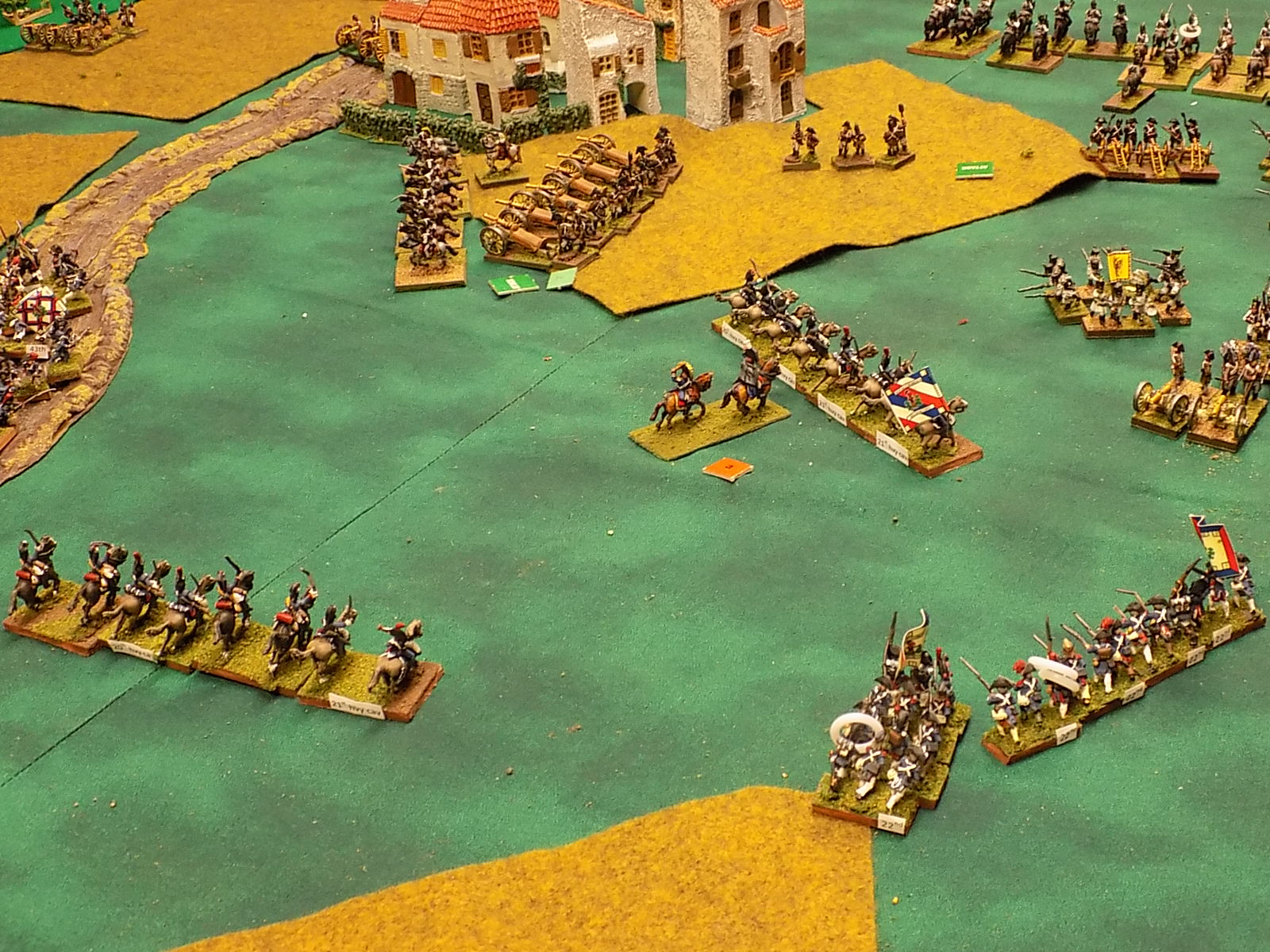
The mixed ME boldly plunged forward, engaging almost the entire French army on table.  Looking back over their shoulders they were dismayed to see that the supporting infantry column was still on the wrong side of the river, having failed their 78% chance of activation.


Elsewhere the Austrians elected to send all cavalry forward, meaning it would be a long time before any infantry entered the fray. 


The main combat developed in the center as the mixed ME hung in there, repeatedly beating the odds to repulse French attacks or maneuvers.  Although they would be destroyed in time, they allowed the tardy follow-up forces to get into position. 


With even the Counselor Guard committed and a reinforcing French ME arriving statistically early, the fray remained close.  Slowly the advantage shifted to the French and the absence of additional infantry support limited their options.


Even Bonaparte can miss a command roll once in a while.  The reinforcing French ME failed to change their maneuver orders and never became engaged in our battle.


Having levered an opening, the French cavalry became active, striking at  the flank of an Austrian cavalry ME and routing it.  Tragically for the valiant Austrians, they failed yet another activation roll and left their next infantry ME on the wrong side of the river.


The quality edge enjoyed by the French begins to take hold and in a one-on-one fight are generally successful everywhere.  The Austrian position is shakey and no additional supports are readily available.


After playing four hourly rounds in four hours we needed to stop the carnage.  The Austrians had so consistently failed their activation rolls that there was no chance of bringing their superior numbers to bear to counter the French quality edge. 

Although I may have erred in only allowing one cavalry ME to cross per hour the dice rolls are really what doomed the Austrians.  The game featured a fluidity we don't see that often with lots of grand tactical movement.  Thanks to the Austrian team of Bob, Dan, Dennis and Jay; as well as the French trio of Eric, Todd and myself (the lost ME commander).