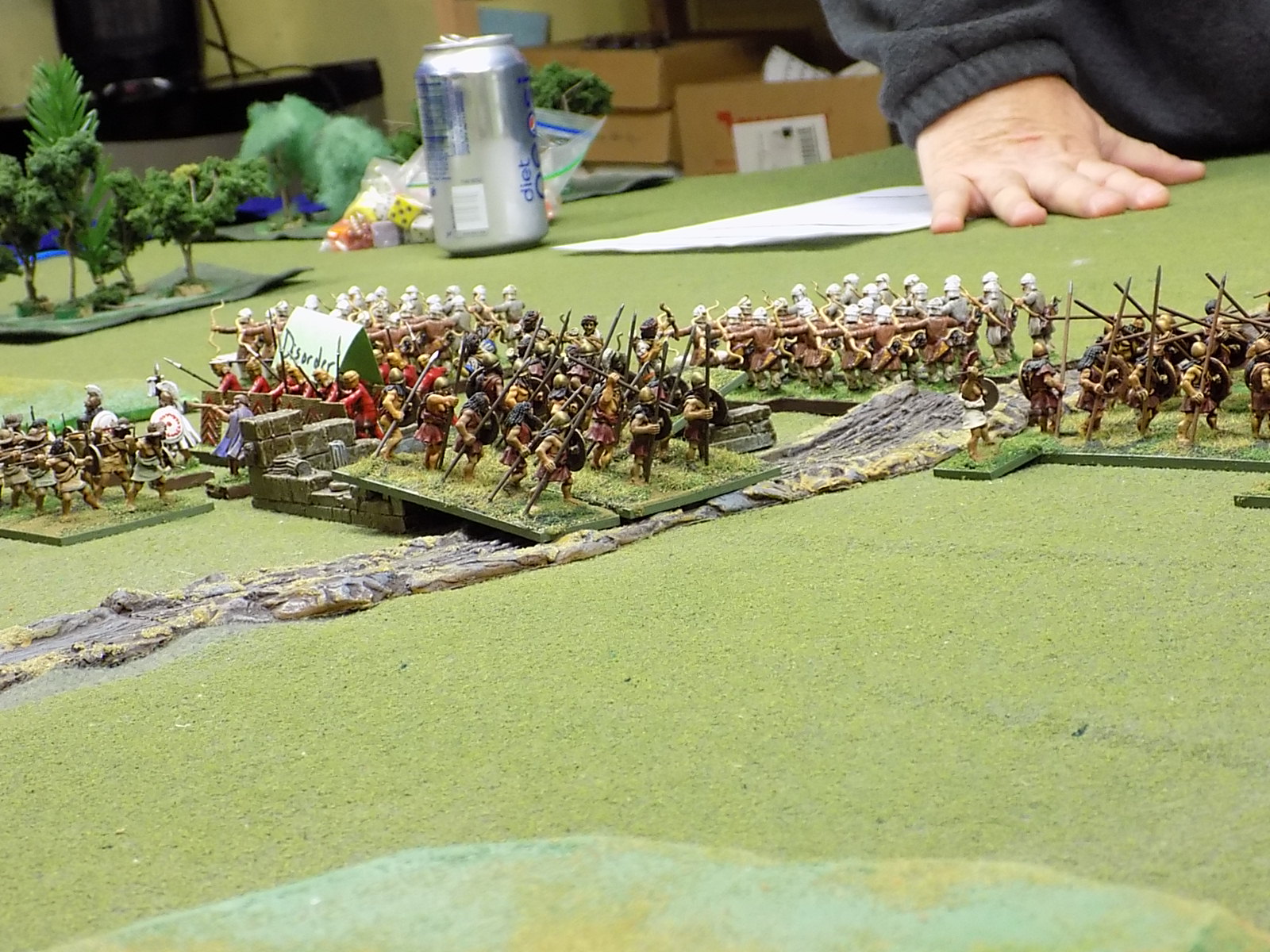
Seven players played an Empire game loosely based on the Battle of Marengo in 1800. Austrian General Melas (poor, uninspiring) has decided to seize the initiative from General Bonaparte (superior, charismatic) by launching a dawn attack on the scattered Republican forces.
In Empire the maneuver elements (MEs) are given an operational order which may or may not be changed by a percentile roll based on the commanders rating. For our game the Austrians were allowed to use a x1.5 modifier throughout since the attack was well planned and understood.

The Austrians were allowed to place one ME across the Bormida River in the pre-dawn hours and one each "hourly round" thereafter at quarter grand tactical speed. At both the pontoon bridge and regular bridge the Austrians chose cavalry ME or "Mixed" MEs to find and fix the French in position. An infantry ME was scheduled to follow across the pontoon bridge.

The French have one infantry ME in the vicinity of each of the two villages with the cavalry in the center. All are operating under a "Rest and Rally" order to reflect their unpreparedness at first light.

The mixed ME boldly plunged forward, engaging almost the entire French army on table. Looking back over their shoulders they were dismayed to see that the supporting infantry column was still on the wrong side of the river, having failed their 78% chance of activation.

Elsewhere the Austrians elected to send all cavalry forward, meaning it would be a long time before any infantry entered the fray.

The main combat developed in the center as the mixed ME hung in there, repeatedly beating the odds to repulse French attacks or maneuvers. Although they would be destroyed in time, they allowed the tardy follow-up forces to get into position.

With even the Counselor Guard committed and a reinforcing French ME arriving statistically early, the fray remained close. Slowly the advantage shifted to the French and the absence of additional infantry support limited their options.


Even Bonaparte can miss a command roll once in a while. The reinforcing French ME failed to change their maneuver orders and never became engaged in our battle.


Having levered an opening, the French cavalry became active, striking at the flank of an Austrian cavalry ME and routing it. Tragically for the valiant Austrians, they failed yet another activation roll and left their next infantry ME on the wrong side of the river.

The quality edge enjoyed by the French begins to take hold and in a one-on-one fight are generally successful everywhere. The Austrian position is shakey and no additional supports are readily available.
After playing four hourly rounds in four hours we needed to stop the carnage. The Austrians had so consistently failed their activation rolls that there was no chance of bringing their superior numbers to bear to counter the French quality edge.
Although I may have erred in only allowing one cavalry ME to cross per hour the dice rolls are really what doomed the Austrians. The game featured a fluidity we don't see that often with lots of grand tactical movement. Thanks to the Austrian team of Bob, Dan, Dennis and Jay; as well as the French trio of Eric, Todd and myself (the lost ME commander).
In Empire the maneuver elements (MEs) are given an operational order which may or may not be changed by a percentile roll based on the commanders rating. For our game the Austrians were allowed to use a x1.5 modifier throughout since the attack was well planned and understood.

The Austrians were allowed to place one ME across the Bormida River in the pre-dawn hours and one each "hourly round" thereafter at quarter grand tactical speed. At both the pontoon bridge and regular bridge the Austrians chose cavalry ME or "Mixed" MEs to find and fix the French in position. An infantry ME was scheduled to follow across the pontoon bridge.

The French have one infantry ME in the vicinity of each of the two villages with the cavalry in the center. All are operating under a "Rest and Rally" order to reflect their unpreparedness at first light.

The mixed ME boldly plunged forward, engaging almost the entire French army on table. Looking back over their shoulders they were dismayed to see that the supporting infantry column was still on the wrong side of the river, having failed their 78% chance of activation.

Elsewhere the Austrians elected to send all cavalry forward, meaning it would be a long time before any infantry entered the fray.

The main combat developed in the center as the mixed ME hung in there, repeatedly beating the odds to repulse French attacks or maneuvers. Although they would be destroyed in time, they allowed the tardy follow-up forces to get into position.

With even the Counselor Guard committed and a reinforcing French ME arriving statistically early, the fray remained close. Slowly the advantage shifted to the French and the absence of additional infantry support limited their options.


Even Bonaparte can miss a command roll once in a while. The reinforcing French ME failed to change their maneuver orders and never became engaged in our battle.


Having levered an opening, the French cavalry became active, striking at the flank of an Austrian cavalry ME and routing it. Tragically for the valiant Austrians, they failed yet another activation roll and left their next infantry ME on the wrong side of the river.

The quality edge enjoyed by the French begins to take hold and in a one-on-one fight are generally successful everywhere. The Austrian position is shakey and no additional supports are readily available.
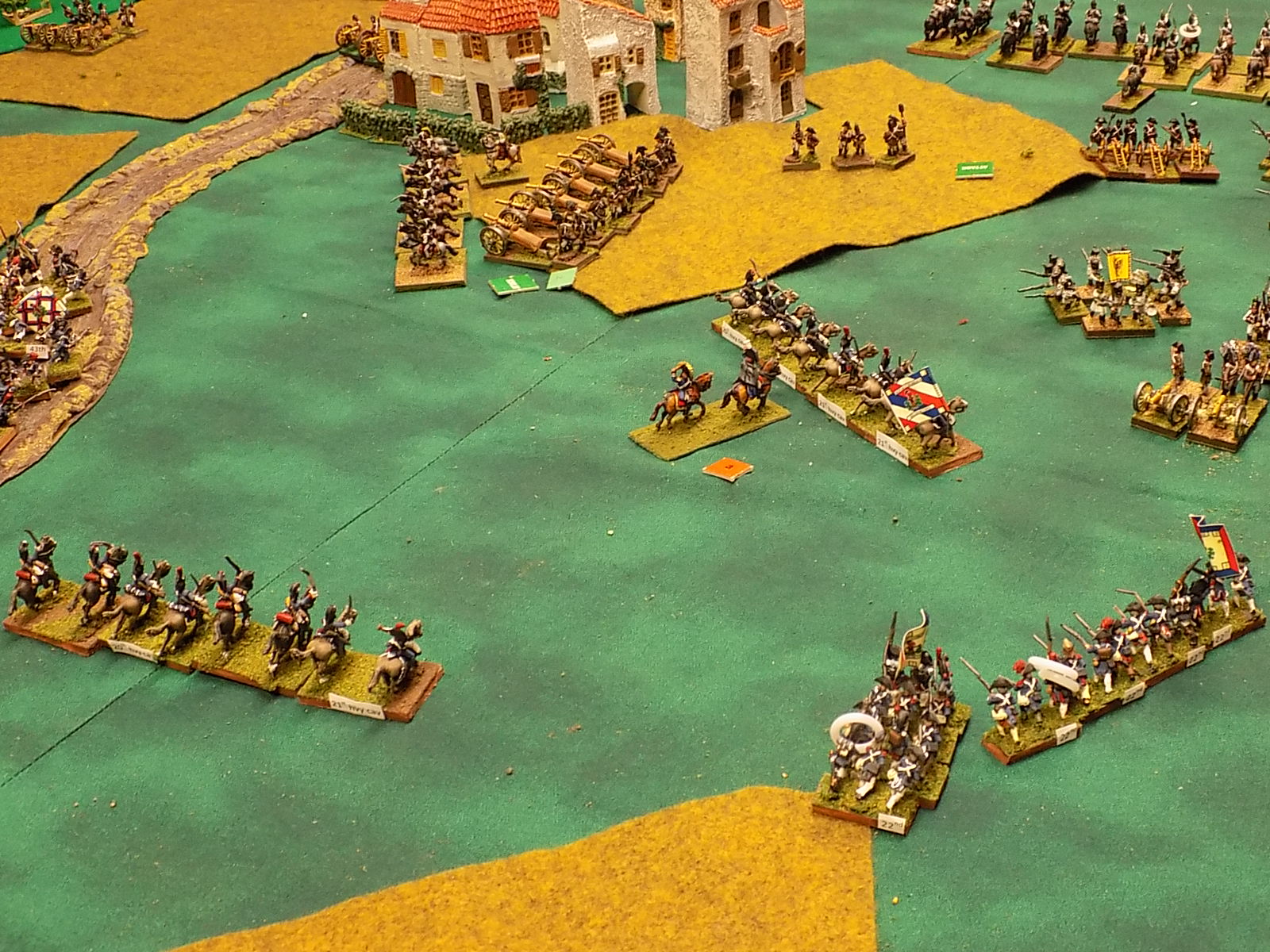
After playing four hourly rounds in four hours we needed to stop the carnage. The Austrians had so consistently failed their activation rolls that there was no chance of bringing their superior numbers to bear to counter the French quality edge.
Although I may have erred in only allowing one cavalry ME to cross per hour the dice rolls are really what doomed the Austrians. The game featured a fluidity we don't see that often with lots of grand tactical movement. Thanks to the Austrian team of Bob, Dan, Dennis and Jay; as well as the French trio of Eric, Todd and myself (the lost ME commander).