Friday, August 21, 2015

Airmen in the Water

In the wake of savage dogfight that drifted over the English Channel a scattering of downed aviators drifted in the sea.  Both sides were anxious to recover their men and perhaps pick up a survivor or two, so rushed light craft into the area.  And hence to the game.

The weather was overcast and the water relatively calm.  As I told the players these aren't SEAL Team members who are trained in high speed pick up, so they would have to go at less than 15 knots during the 30 second turn the pickup was attempted.  (In the end I forgot to make them do the snag and drag roll, so all pick-ups happened automatically.)  Rules are Flaklighter, miniatures are 1/700 scale and the aviators were positioned by tossing a handful of pennies over the table.  When picked up we rolled a dice and odds or evens determined nationality.

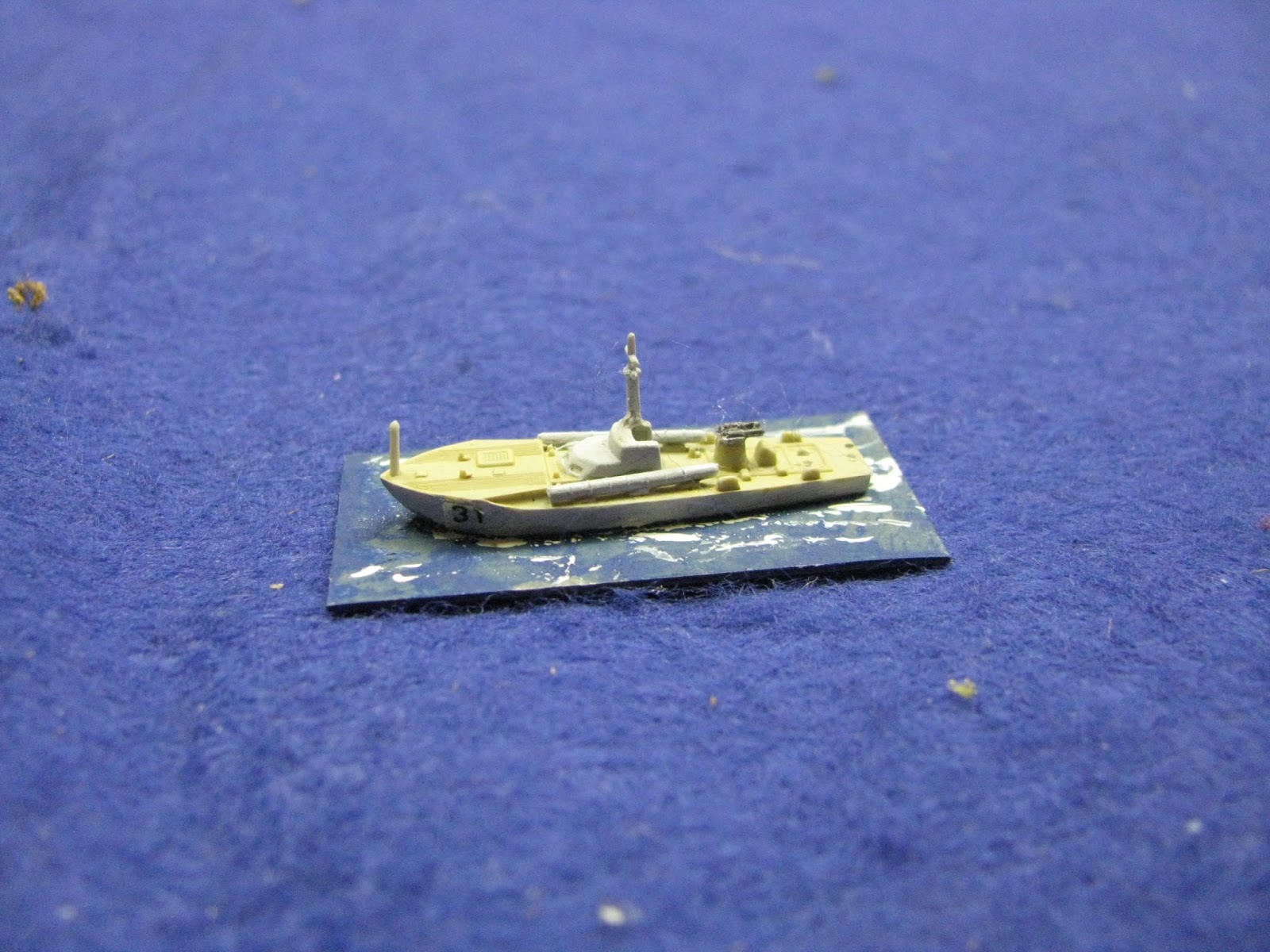
 Two Schnell-bootes with a 20mm gun fore and aft, two LMGs midships, and two torpedoes with reloads.
Four Vosper MTBs with twin HMGs in a turret and a LMG at each torpedo tube.

The coin toss favored the British, who closed quickly.  Two boats went to engage the larger, more powerful S-Boats while the other two attempted to make rescues. 


No one's gunnery was particularly effective as the fighting ships were racing at high speed.  Even this point-blank pass failed to score any hits.

In the end the British boats grabbed two British and three German aviators, while the Germans only picked up one German.  One of the Vospers was severely damaged and another mysteriously went off the wrong side of the table, but a Schnell-Boote was reduced to half speed so they could not pursue their lighter opponents further.  Seen here forming up to make their escape.

An introductory game I kept it simple and we were done in less than two hours.  Everyone wanted vessels with more firepower.  Perhaps next time we will get out of the early years for the more powerful coastal craft.  Everyone was in agreement that we should play again.  My thanks to what is turning into the Thursday night crew for gathering again this week.


Tuesday, August 18, 2015

Crush the Revolution

We had time for a weeknight game so we opted to run Todd's Republican French again, this time against my 1806 Prussians.  They are new (to me) figures and needed blooding, so we rolled the clock back a bit and had at it.

Twenty-four French line and light battalions, with six cavalry regiments and four Class I batteries were opposed by twenty Prussian battalions, eight cavalry regiments and five Class III batteries.  We arbitrarily chose 1794 for a game date and used the values in Empire associated with that time range.  The French were led by Kleber, Excellent/Inspirational; and the Prussians by von Ruchel, Despicable/Impersonal.

The initial French deployment, with the infantry in three small divisions.  Light cavalry on their left, battle cavalry on their right.

The Prussians with four brigades of infantry, light cavalry on the left, medium in the center, and heavies on the right.  Confident of course in their linear tactics.

A setting on my camera was off so I ended up dumping a bunch of blurry pictures.  The short version is  that even with the first turn bonus to activate, half of the Prussians refused to move on the first Grand Tactical.  Fortunately the French were equally aggressive and far more effective, so we got engaged.  Surprisingly, the Prussians won the initiative and the heavy cavalry on the right eliminated the French lights.  Supporting troopers forced the French into square, delaying their attack.

The Prussian left easily held as the French sorted themselves into lines, and the light cavalry on the left traded successes and set-backs equally.  On the second hourly round we again won the initiative as von Ruchel lead a cavalry brigade forward on the left.  Although bad initiative rolls again limited our options, we made good progress on the right and left.  Some French battalions were routed and we seemed to be winning the cavalry fight against the French heavies by sheer numbers.  When the French finally won the initiative it was probably too late to matter.


With steady Prussian lines advancing everywhere and the cavalry either routed or neutralized, Kleber broke off the engagement, the always fleet-footed French easily getting away.  Lots of satisfying action in a three-hour game.

Finally, despite the success since Empire rates him as Despicable/Impersonal, it seemed only fitting to give von Ruchel appropriate Aides. 

See?  Contrary to popular myths, Napoleonic gamers do have a sense of humor.

I'd be lying if I said these early-war games aren't causing some consternation and rethinking of tactics.  The narrower than we're used to French columns really emphasize the need for firepower.  Meanwhile, the Austrians (last game) and Prussians in this one feel slow and awkward.  Next game I'll try out my Republicans and see if I can do better.  Thanks to Dan (my fellow Prussian), Todd and Bob for playing.
 

Tuesday, July 21, 2015

Republicans and Austrians

I was anxious to play with my newly recovered Austrians and another player has a Republican French army based on Marengo that needed table time so we put together a small game, using our favorite system, Empire.

The French were organized into two divisions, under the over-all command of Joubert, with heavy and light cavalry in support.  The French infantry at this point is 90% veteran line and above.

The Austrians, under Belegarde had four brigades (one of grenadiers) in their column.  As a "regimental army" in Empire we had far less tactical options once battle was joined.  Plus our regular infantry were all rated as conscript.

The Austrians attacked on the right and defended the left, though the grenadier brigade somehow didn't get the word and continued to pick nits out of their bearskins.  Cavalry advancing engaged the troops and stopped further movement during "Grand Tactical."

The situation on the Austrian left.  Mostly defending in shaky lines while the French advance in column prior to deploying into line.

In the early cavalry clashes the Austrians typically held an advantage but could never rout their foes.  The French always were able to fall back in good order.

On the left the French got themselves into line and used their cavalry to force the Austrian infantry to square up in front of them.  With no infantry in close proximity it was the safe move.

As the French attempted to attack on the Austrian right the Schwartzenburg Uhlans had an opportunity for a devastating charge and scattered most of the Consular Guard.  With their best troops routed, it took all the steam out of their attack.

Slowly, the Austrians began to put serious pressure on the French.  Despite being thrown back in the first attempt, the threat was very real.

Seeing the trend, the Austrians came out of square and began to advance across the front.  The large Austrian battalions, while of weak morale, are hard to get to the point where they are testing.  A battalion in line rated conscript would have a 58% chance of routing on their first required test, but they would also have to lose six of eighteen castings.  So it provides a measure of balance.

And we called it a game.  The French could no longer attack with any reasonable chance of success and the sluggish Austrians cannot catch them in pursuit.  So mission accomplished for the four of us who played.  We enjoyed "new" old troops back in my collection and the French got on table.

For our first Empire game since the Waterloo spectacular in April we found we were very rusty and had to look up a lot.  The problem with playing so many different games.  Now to finish my 1806 Prussians!
 

Friday, July 10, 2015

Aw nuts!

Sunday, June 28th was our regular "Ranger" Flames of War game at Adventure Games in Oshkosh.  I had only been back in the USA for three days, but despite feeling like I was still at 20,000' and flying at 300 knots, I went down to try out my Americans.  Hopeful of getting more players we agreed on 2500 late war points.  In hindsight, a mistake.  Mission was "Hold at All Costs" so the Germans had half their force off table while I had all of mine, but they were dug in and had a unit in ambush mode.

When I arrived we had a new player (1st game) name Kyle who brought his Soviets.  He wanted to play with them so I pulled off stuff to allow for some of his mass of armor to play.  In retrospect, we had too much stuff crammed into a 4x6' table.  Made the defenders task easier.

Over-crewed Panzerwerfers await.

Initial set, Soviets on the left.  Looks promising, nicht wahr?

Able to take out some Panzergrenadiers early and pin the 88s.

Italian campaign TDs don't get to teleport, so they wait for good
targets to appear.  Air support is frequent, but ineffective.

A Panther platoon ambushes the Soviets from cover.  Hen and Chicks!

Some token success, but motivation tests succeed and Soviets are
quickly eliminated.

Moving on an objective as, in one of his few dice failures, Paul
doesn't get reserves immediately.

US engineers in the center use their HMGs to combat the 88s,
eventually killing one.

With the Soviets all dead or run off, aircraft can ineffectively
attack.

German reserves begin to pour on and take a heavy toll.  The
German dice were hot to say the least.

Italian Semoventes in German service advance.  US TDs fail
to stop them.

With the objective contested, Panzers assault.  Copious bazookas
miss or are saved against.  We are driven back.

My TDs are eliminated by stationary fire.

And so I conceded the game with no reasonable hope in sight.  Hard fought we got to use lots of new stuff.  We also met another new player in the area, Roy.  Very experienced player also with Soviets.  We look forward to lots of Eastern Front games in the future.

Thursday, July 9, 2015

Waterloo 1815-2015

It was my great pleasure and honor to partake in the 200th anniversary event in Belgium this year.  I would need a dozen posts to relate all that happened, both in the event and with the time we spent in Paris and Brussels and the Ardennes as part of our vacation.


We had twenty-one Americans traveling over, together or in small groups to participate.  We joined our parent regiment, the 21eme Regiment d'Infanterie de ligne on the Thursday before the festivities.


Combined we had 72 in camp and our combined battalion fielded 194.  Around 6000 infantry, cavalry and artillery participated in  total.  We drilled for hours on end and found that the distance between camps precluded visiting for all but the hardiest.  Having put many, many miles on my bad feet being a tourist, I wasn't inclined to add more mileage.


When we marched out for the evening "spectacles" (to maximize profit for the organizers) we were confronted by tall barley fields that hindered movement and huge numbers of allied troops.  Not wishing to be exclusive, one could see British, Dutch-Belgian, Prussia, Russian, Austrian and Swedish troops.  Plus probably some I missed seeing.  Here are some scenes from Friday night.


The Lion's Mound, wreathed in smoke

A square, nestled in the barley

We arrived back in camp about 11:30pm and with "la Diane" coming at 7:00am there was little partying.  Saturday was more of the same, though the "spectacle" was far more enjoyable.  There were many things about the event that strongly differed from ones in the US or Canada.  We were given tins of sardines, bags of peanuts and chips, and cans of vegetables for "rations."  Fortunately the 21eme had a meal plan in place.  If you wanted to use the clean facilities it cost a Euro.  Food and beer (especially) could be purchased fairly cheaply however.  Saturday night was very exciting.

Not mine, didn't write down the artist's name

Photo by Andrey Popkov

Photo by Andrey Popkov (I can be seen in the back left)

Scots Grey and I exchange sabre blows, photo by Andrey Popkov

Photo by Andrey Popkov

As we retired from the field the allied cavalry got very aggressive.  Very aggressive.


The cost was very real.  Tragically, there were four fatalities at the event and the ambulance was a familiar sight around camp and on the field.  While many handshakes were exchanged when we assaulted Hougomont or la Haye Sainte, the open field melees were more like a rugby scrum and firing was done extremely close to one another.  Strangely enough, the reaction to the deaths in Europe was, "with so many involved that is not bad."

Having done battalion drill a few times in Europe now, I can say that as a wargamer most rules make battlefield evolutions too easy.  I'm very proud of our battalion for how well we performed.

Photo by Jean-Francois Schmitz
On Sunday we all went to the battlefield marker for our regiment.  It notes our engagement with General Pack's brigade.  Our flag and Eagle were presented to us by the modern day 21eme.


Vivandiere and Lieutenant

On Monday, despite Belgium being closed on Mondays, we took a short tour the the Ardennes, visiting Bastogne, St. Vith, and la Gliece.  My high school history teacher fought with the 101st throughout the war.  506th, I Company.  God bless you, Mr. McGowen.