Wednesday, December 26, 2012

Stuff... you know... stuff!

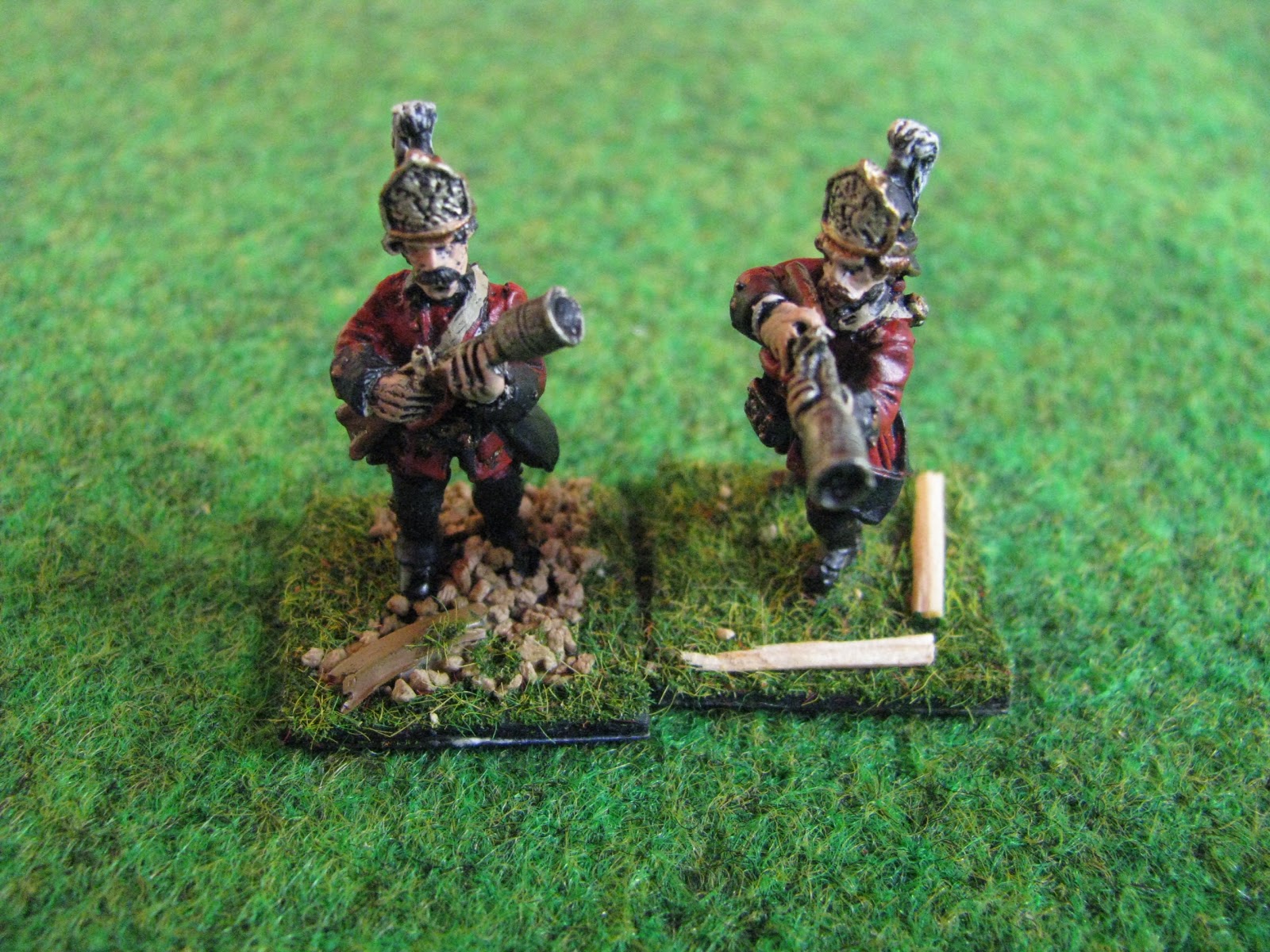
As my painting/gaming year draws to a close I have some "cute" things to share.  I'm not one for impulse buys, having the frugality of a Scotsman, in a Welshman's body.  But when I saw a pack of Foundry Russian SYW hand mortars, I had to have them.

I have no idea how they will fit in our BAR games (Batailles des Ancien Regime) or whether they even should, but how can you resist a weapon you can put your fist down the barrel AND fire it from the shoulder?  There were six in the pack with different poses.  I painted up these two and we'll see where it goes from there.

Next up, an "objective" and some tank camo.  I have the questionable pleasure of playing Flames of War which calls for objectives to serve as an artificial purpose of the game.  Being of that frugal nature again, I am loathe to play 12.5USD for something I can make, so I give you the HQ!


Here we've dropped to 15mm scale.  The whole thing is basically "gubbins" as dear Mr. Grant used to say.  The sandbags are leftover from some toy set, wheels from a Bofor, frame for the netting made from sticks and we're ready to go.  The netting is some leftover gauze from a mosquito screen we made for our tent.  Some watered down paint, white glue and then a matte spray to stiffen it up a bit and we're golden!  Nothing spectacular but certainly functional.

Having some left-over I decorated the barrels of some of my Fireflies.  I had seen pictures of attempts to disguise the long barrels so as not to attract extra 88 shells and this seemed to work well.


I may darken them up a bit or add some tiny tufts of foliage.  We'll see how my mood goes.  So one last look at the HQ, now inhabited by a Soviet command stand and we'll bid you a good night.
 
Good night!


Monday, December 24, 2012

Celebrations and Reflections in Litharus

News of the great victory outside Breslau (see previous post) reached the common people of Litharus about the same time as the first casualty returns and wagon loads of wounded began to arrive home after a rough, three week ride.  Reactions varied across the Grand Duchy, ranging from euphoria to a heartfelt desire to see the war end, to the reflection of the faithful.

A few kilometers north of the city of Šiauliai, a phenomenon began to occur.  Crosses began to appear on a hill that had often been part of the defense of the city.  It began to be a place for the faithful to pray for future peace and for loved ones lost in the wars.
In future years the Hill of Crosses will come to symbolize the determination of the people to keep their faith strong in the face of all the world will throw at them. 

---------------------------------------------------------------------------------------------------

I've taken the liberty of turning the clock ahead 70 years and starting the Hill of Crosses early in my Imagi-Nation.  In the real world we approach Christmas trying to remain firm in our faith as news from home and abroad would seem to indicate all is going to madness.  So I offer this post as a reminder of faith, determination, patriotism and a sincere wish for peace.  May the day come when all the battles are fought on tabletops with dice, laughter and good will.

Merry Christmas and peace be with you all.

Thursday, December 13, 2012

Battle of (near) Breslau - 1762

In the closing days of 1762 and as the campaign season draws to a close, the forces of Russia and Litharus gathered to meed the Germanian hordes once more, as lead by der Alte Fritz himself.

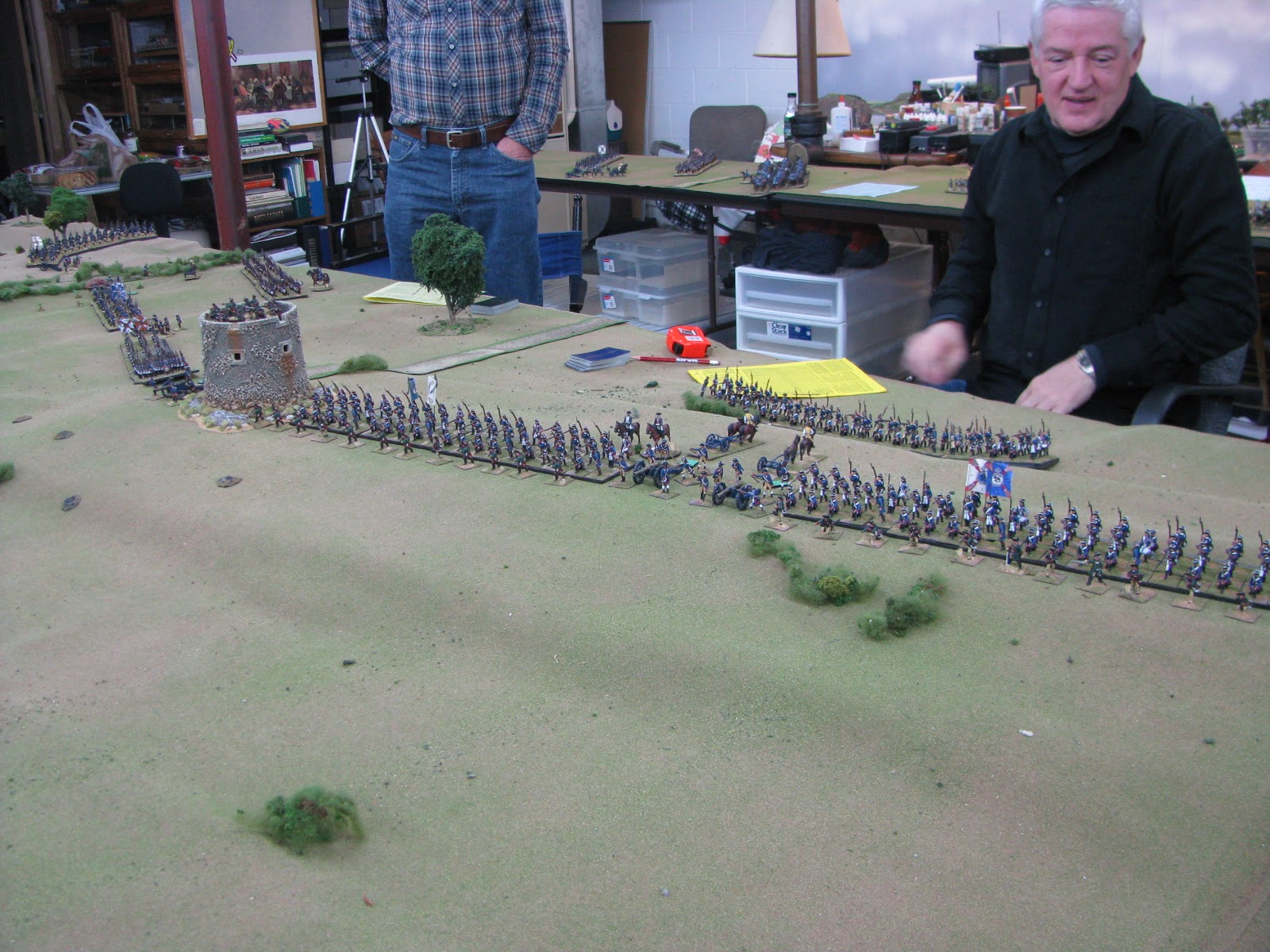
By way of background the rules are Batailles des Ancien Regimes (henceforth to be called BAR); a card driven system at 1:10 scale where the 24' table is divided in two with a deck of cards for each end.  The turn of said card determines who moves first, and after all movement is complete, another card determines who fires first.  If a Joker is drawn another card is played to see who gets it.  This allows that side to trump a future card turn.  Quite critical as it turned out.  (Click to enlarge pictures.)

In round numbers, the Germanians fielded 16 battalions of at least 60 figures each, 10 squadrons of cuirassiers, 6 of hussars, and some number of dragoons.  The Slavic forces had 17 battalions (to compensate for a quality difference), 10 squadrons of cuirassiers, 7 of Cossacks, 3 of dragoons and 3 of horse grenadiers.  Both sides fielded a mix of heavy, medium and light guns.  Russia provided two of their "secret howitzers" which we determined to only fire heavy case shot.  No round ball.  So very effective up close, but no good for bombardment.  I think we had them out-gunned 10-7.

Although styled as a "meeting engagement" the Prussians started on table while the Russians had to march on.  An "L" shaped ridge line was the objective of the day.  Smack in the middle of it was a stone tower that we all predicted would be full of the verdammt Prussian Jaegers.  We were right.

Now although it would seem that many advantages fell to Frederick, it was a tricky position.  The ridge was long and the L shape provided us with a natural "hinge" to hit.  He was too smart to give us that edge so they strongly defended from the tower on down, but didn't put their neck into the noose at the point of the L.

Open woods were found on each end of the table, so the plan developed by Generalissimo John Makolondra(vitch) was to have the Cossacks, Pandour battalion and two line battalions hook in from our left. 

A brigade of musketeers with strong artillery support under General Olson(neevobeech)would go at the hinge (even though we knew in our hearts nothing would be there), all four grenadier battalions and two more musketeer would be held directly behind them in reserve under General Beck(owski), the cavalry heavies would be to their right under host and author of the rules General Protz(ki), while I was the blocking force on the right with four line battalions and the dragoons and horse grenadiers. 

It was thought that the Germanian forces might use the more open ground on our right for their magnificent cavalry, so I expected a difficult day.  Alas, my opposite was also operating under delaying orders so we spent much of the day smiling and looking at each other.  Which is fine we me, I like to see a plan executed rather than a scrum.  But, to the battle....

Besides the 24 x 6' table, there are also back tables which aren't just for staging troops or placing casualties, but are in play.  Every game someone gets caught by forgetting the table edges in theory butt up against each other.  Today was no exception as our left hook got caught in the flank by the opening volley of a Prussian battalion that sent many noble Cossacks to an early grave.  As our main attack stepped off we began to be peppered with galling fire from the Jaegers, who occupied the tower and were spread out in front of the Prussian line in a rather Napoleonic style. 

The Litharusian brigade closed rapidly on their adversaries with the intention of putting the question to them quickly.  Immediately the Gods of War smiled upon us by granting us a joker on one of the first couple of cards.  This had a profound effect because as the two advancing lines closed on each other a Prussian firing card came up.  Trumped by our joker!  A truism seems to be, however goes the first volley of the game, so goes the game.  The result was most satisfactory for our side and we shortly had the Prussians shifting backwards onto their reserves. 


On our left where the Prussians were being aggressive the Cossacks and their supports had to quickly realign themselves to face the threat.  All the pressure now went onto General Olson-eevabeech to break through. 

Things see-sawed for a time on the left-center (our perspective) as galling artillery fire emptied a few cuirassier saddles and the grenadiers awaited their orders.  A courier from the right (me) came to the general asking for permission to attack, as I judged to have a small advantage in infantry and an important advantage in cavalry, being the heavier force.  Eventually, after riding the 96 inches in each direction, I was turned loose. 

The first Litharusian brigade, although routing a pair of Prussian infantry battalions, was running into hard times with the new forces coming up against them.  The two garrison battalion leading the assault did honorable service, but were routed in their turn.  One managed to rally though.  The fresher battalions now uncovered advanced to continue the damage to the Prussian line.
 
Somewhere in here the left was stabilized or even going slightly our way, the right was finally advancing, and the grenadiers and cuirassiers were turned loose.  The cavalry charge and results can be viewed here.  The grenadiers and supporting musketeer battalions looked invincible as they advanced. 


On the right Russian dragoons and horse grenadiers clashed against lighter-weight hussars, but the Alte Fritz mystic, coupled with my horrendous saves, prevailed and no clear winner emerged during play.  Everywhere the Prussians seemed to be in retreat or desperate counter-attack as we hit the time deadline.  That joker, early on, had a huge impact the entire game. 

The mass of Prussian heavy cavalry and guard or grenadier reserve was intact, so while we were going to take the field, no serious pursuit would likely be mounted.  While they covered themselves with honor and glory, much of our heavy cavalry was a spent force.


As always the game was characterized by fair and honorable play with success and adversity met with equal aplomb.  We are a fortunate group to be able to strongly contest the battlefield, while laughing and enjoying each other's company.  За нашу дружбу!

Monday, December 10, 2012

Europe in Flames of War (Tourney)

Sunday we completed our cycle of 1500 point Flames of War tournaments at Gnome Games in Green Bay, WI.  The early-war, mid-war, and late-war tournaments had the faces change but the numbers remain constant at six players.  I missed the early-war session due to real world considerations so my Italians remained sans glory.

The mid-war tourney was won by my Panzergrenadiers, 10.5 cm guns, Mk III tanks, Marders and mostly importantly, 2 cm self-propelled AA.  In one game they shot down all eight Sturmoviks that came my way.  Unfortunately I forgot to bring my camera so no pictures.

This round all three scenarios were created by our judge and referee, Dan Wideman of Neenah, WI.  I had intended to field a British or Czech force.  Easyarmy.com is great and inexpensive way to generate multiple army lists if you don't want to buy $50 books.  But the anticipated line-up would have meant some "blue on blue" games, so I want back to Panzergrenadiers.  My "Confident-Trained" list from the Panzer Brigades East supplement had two platoons of panzergrenadiers, six Panther tanks in two platoons, and a battery of 10.5 cm guns.  In this list the panzergrenadiers gave me intergral 2 cm AA models so I didn't need points spent there.


The first game had me going up against a "Fearless-Trained" Polish group.  They had a nice balanced list with a full battery of 8 25lbers, Vicker HMGs, and two platoons each of infantry and tanks.  Only two Panther killers though besides the artillery.  The scenario called for the Poles to deploy first and for the Germans to have the first move-shoot.  This combination plus the relative inexperience of the Father and son team of Mike and Thomas led to a short win for the Germans.  Just getting started in historical gaming, I suspect they will be a force to be reckoned with after a few more games.


Round two had me facing Jake's all armor (or should I say armour?) list.  Loads of Shermans, recon Stuarts, recon Bren carriers, Sextons and Typhoons.  The Germans had to deploy first, fully dug in, but could hold two platoons in ambush.  Guess which ones?  My AA had the dubious choice of staying in the open so they could shoot planes (and die), or hide in the woods and be useless.  I tried for the former.  The scenario called for me to do a fighting withdrawal.  Each turn I didn't withdraw a platoon I added a pip to a counter.  Once the pips and number of platoons reached 8 I had to pull a platoon off table.

The game developed fairly quickly with the Stuarts and Bren Carriers rolling forward as the Sherman platoons moved more cautiously.  Faced with the prospect of losing a platoon quickly (I started with five) the first ambush was sprung as the Panthers wiped out a squadron of Shermans.  But then the Typhoons swept in killing Panther each of the next two turns.  My armor saves were horrendous.  The third Panther went down from a rear shot by a Firefly.  Meanwhile the other ambush had knocked out three Shermans the round it was sprung but another trained Panther died.

Finally a combination of artillery, panzerfausts and the surviving Panthers finished off the British.

 
The last round I fought a "fill-in" force.  A British veteran recce squadron was the base force.  Built around armored cars, with two squadrons of tanks and limited air support.  In this game by AA support controlled the sky and they had little that could hurt the Panthers.  In exchange for two Panthers Bob's British force was eliminated except for two armored cars from the HQ element.  The panzerfausts possessed by every stand contributed to the victory.

So in the end, by virtue of the level of victory I won the tournament though Andrew's German all armor force also won all three rounds.  In fact, the Germans overall were 8-1 winners.  I guess I have to give credit to Flames of War for accomplishing what they set out to d;, give a vaguely historic result in a short period of time.  They let us into the building at noon, didn't start play till after 1:00 and finished the three rounds by 5:30.  A well invested afternoon.

Saturday, December 1, 2012

Nishnabotna River Pt. II

As the battle resumed, the situation was such that one of the bridges over the Nishnabotna had been crossed and the Union forces were pouring across the ford.  Only in the center was the situation still in hand.  For the moment the Confederates had an advantage in numbers across the river.  While they would never be able to attack across themselves, they might destroy the isolated forces on the near bank.

The remaining Reb cavalry began to mass on the right to try and delay or get an opportunistic charge in against the Yanks.  In the center the two brigades of Whither's division sorted themselves out from march column while Cheatham's division, already in line, dallied.

As the Yankees and Rebs began to exchange long range fire, two regiments and a battery from Donelson's usually steady men bolted at the first fire received.  (Damned "snake eyes")  The first of several unexpected and precipitous routs this night for the Rebs. 

Even when charging into the (refused) flank of the Yankees stalled without closing.  Small consolation was the elimination of a few Union stands and a regiment.  While some respite was gained by Yankee delays crossing the bridge and ford, the exchange of losses in the middle without coming to grips only served to aid the Union cause.  The Reb cavalry enjoyed some success finally on the right, running off or meleeing to extinction some units, the success only served to draw in the brigade of Whither's sent there.  They would suffer for their aggression later as the Yankees figured out how to utilize their numbers and threatened to cut off the brigade.

In the center a well-timed and executed charge pushed back Whither's other brigade and only a remarkable sequence of point blank fire coupled with a natural 24 on four dice stopped them.  Still, all hope of securing the bridge and ford was lost as weak dice and lack of aggression where it was needed doomed the Rebel cause.

Kudos to the Union forces for a well-planned and executed attack that while costly, was complete and total victory.  Tip 'o the kepi for Dan's imaginative scenario idea and to the players for patience and goodwill as the good/bad luck streaks ran.
 

Thursday, November 15, 2012

Crisis on the Nishnabotna River - Part 1

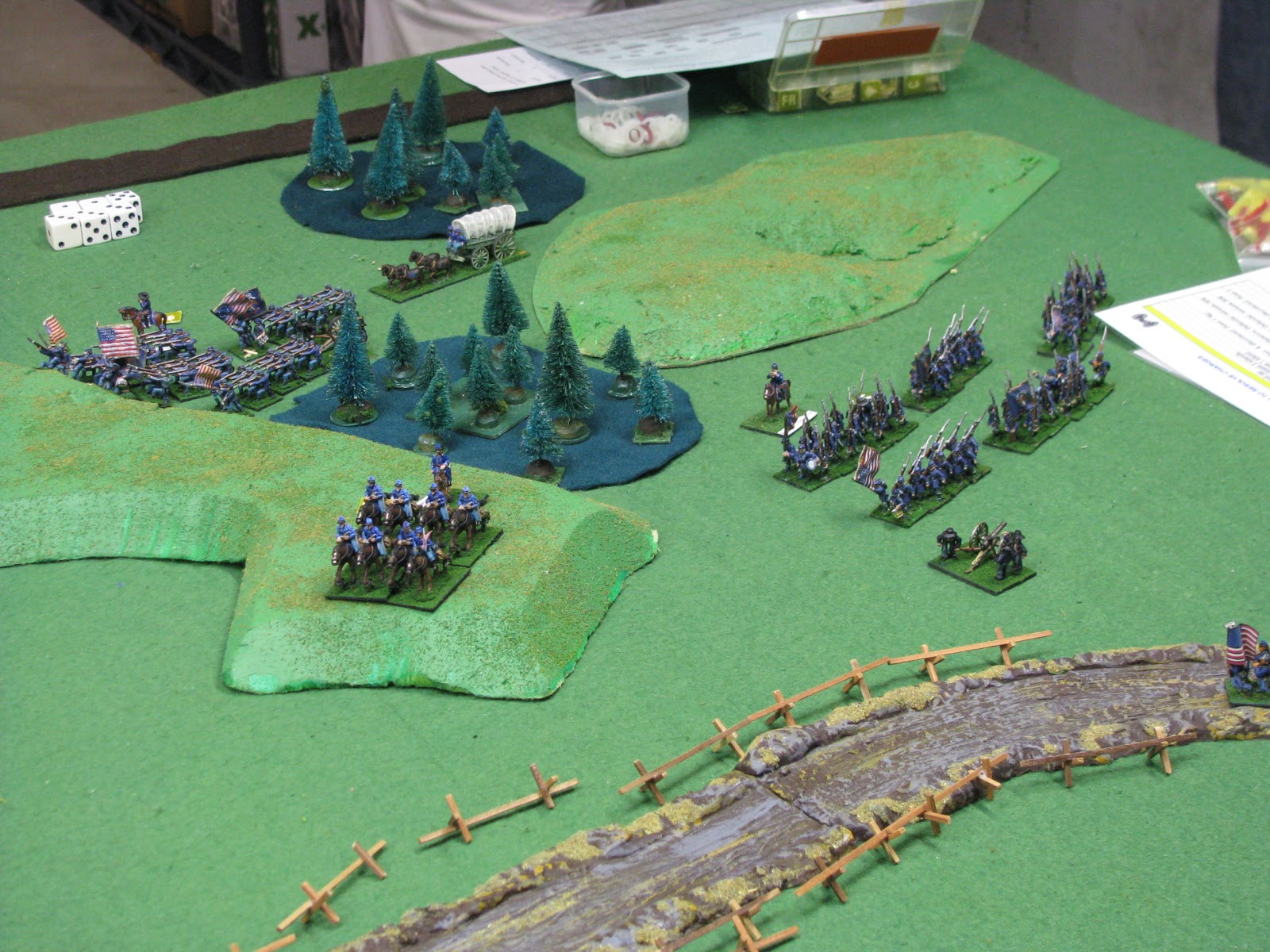
Sometime in the first half of 1863; somewhere along the Nishnabotna River (it really does exist); Joe Wheeler's cavalry stood in anxious anticipation of the arrival of the Yankees.  Having just arrived a bit before the Union forces there was no time to do anything but spread out to thinly cover the bridges and the general area of rumored fords.  Five regiments of elite cavalry and a rifled battery of borrowed guns to cover a huge amount of ground.  Buford's cavalry was coming up fast and Polk's infantry corps was also marching hard, but the Yankees would get there first.  Lots of 'em.

The Nishnabotna was considered impassable except at the bridges and a ford.  Two sections of river were designated as being candidates for a ford.  Each turn spent at the river earned the roll of a d6.  When the total of the rolls got to "12" a ford had been found.  So in theory in two turns, or more likely four.

Turn 1 the Yankee cavalry under Crook came on table.  A full 9 regiments and one battery strong.  They were evenly divided and each initially headed for the bridge in front of them.  A remarkable salvo from Wiggin's Arkansas battery scattered the lead regiment and fled back the way they came.  On the Rebel left the two regiments defending saw cavalry and artillery coming at them.  They had chosen to defend the most forward of the two bridges along the fork in the river dismounted.  Two to one odds and Yankee artillery did not bode well.

Next turn on the right the Union cavalry, apparently not noticing their fleeing comrades, pushed on and likewise were greeted with a staggering shot at normal range.  Cavalry in march column against artillery is not a good thing and they joined their brigade mates in precipitous "advance to the rear."  The left however saw the Rebs remounting and attempting to get away from the soon to be barrage of firepower.  As some Yankees dismounted to bring fire on the reforming Rebs a strong regiment slipped across the bridge, did a crisp wheel by troops to form line and faced the remounted Rebs.

Turn 3 Buford's cavalry started to arrive but by different routes so by default some were out of command.  On the left the two opposing regiments charged each other while the second Reb regiment, who had mounted up facing away, headed for the second bridge and momentary safety.  A cannon shot emptied a handful of saddles but as the two lines met the Rebs held the slightest of advantages.  To no avail as the Union troopers overthrew their opponents and threw them back in disorder.  A brief discussion and we decided that since they had to carry on with the charge they would pursue their nearby original target rather than the inviting backs of the other Reb unit.  The subsequent melee left the Rebs short one unit with a damaged Union one in return. 


On the right the Union cav started to get out of the way of the infantry as well as out of normal range for the rifled cannons.  Wiggin's failed to replicate their remarkable run to this point, only putting a single hit on their intended this time.   Adding to the Reb discomfort a long column of "blue bellies" from 1st Division, XIV Corps began arriving as a sign of things to come on Turn 5.  It took three turns to get the whole three divisions on table, though in nothing yet resembling battle array.

Turn 7 the only thing giving the Rebs hope was the traffic jam at the bridges.  "Get that cavalry out of my way" snarled the divisional officer of the lead division on the Reb left.  As the Reb cavalry moved away the hungry Yanks followed in what was looking to be grim.  On the right the Yankee infantry shook itself into battle order and started advancing.  The Reb artillery found the range again and a fourth Yankee cav regiment headed back to their recruiting depot.  None had been rallied to this point.  In the distance Ben Cheatham's division was arriving but had a lot of ground to cover before they could come to grips.

In order to buy time and delay the Yankee advance, the 1st Tennessee and 1st Alabama cavalry expended themselves in charges.  The cost was great but it was necessary to give the Rebs a chance.  With two brigades of Wither's division, along with all of Cheatham's division arriving, the Rebels might have a chance to crush the Yankee force already across before the others could get over the ford in strength or rush the other bridge.


So there is the situation, the table has been set.  The Yankee cavalry is largely ineffective and the Confederate cavalry has only three regiments and an "out of ammunition" battery.  The Union army has infantry across the river in two places and threatens the third.  Difficult choices face both commanders as they have to decide between bold advance(s) or measured assaults. 

Rules are Johnny Reb III with a few amendments.  Six players were present and roughly nine or ten turns were played.  We have the luxury of leaving it up though with the upcoming holiday it will be two or more weeks before we can finish it.  Everyone agrees that it is one of the most dramatic ACW games we've had for quite a while.  Tune in for the exciting conclusion....


Sunday, October 21, 2012

Rock-Con 2012

After missing last year, Peg and I returned to a semi local (three hours away) favorite con this weekend.  Held in Rockford, IL it is ostensibly a Friday night through Sunday event, though in practice little tabletop gaming seems to occur on Sunday.

Besides miniature, boardgame and RPG gaming, the event features a silent auction, decent dealer area, painting competitions and the very popular "paint and take" area with donated figures and paints.

My Friday night game was with Bonaparte with the scenario set in Spain in 1813.  It wasn't my first choice but the game in North Africa had only me sign up.  Not being a fan of one against the ref games, he kindly excused me and I went to try and help get a supply column off table in the face of British, Portuguese and Spanish forces.  The game system is fairly simple.  Two range bands for musketry, d6 resolutions for firing and melee, and d6 or d10 for morale.  The French were marching out of a mountain defile so my brigades could only come into play as each unit cleared.  Cavalry moves are special in that if they declare a charge they get to do a full "maneuver" move including wheeling before you can react.  So if you get within a move of infantry and then charge, they have no chance of forming square.  This "motorcycle cavalry" dominated the game and sort of saved our bacon.  For as my unit emerged I was immediately taken under fire and then charged by the enemy that had just come on table to my right!  So not only was I out-gunned 10-4, out cavalried 2-1 and out-manned 9-5, but they got to start on my flank.

My cavalry launched the first of many desperate charges that *had* to succeed.  My attitude was to just buy time but to the surprise of many they kept winning or surviving.  Some fortuitous dice rolls by the enemy (thanks Ron) helped and I got a few infantry units on table.


At the end of regulation play I had lost one infantry unit but had routed several enemy and gotten my command out of the pass.  They gave me a prize, redeemable in the dealer area.  The scenario continued in future sessions and despite the long odds the French I think ended up winning.

Peg in her first game, a "4.5 D&D" system

Saturday morning I got into my main reason for coming game, Command Decision: Test of Battle.  The scenario was a breakout from Kiev in 1941.  Not my favorite period of the war, but I volunteered to be Soviet, "for the challenge." 


We had four groups of one tank brigade and a regiment of infantry each.  Troops were green, morale 8 for those who know the game.  Each tank group had a KV-1 model, two T-34s, six T-60s and a armored car model.  But, to represent the chaos of the opening days of the war and the retreat situation, we could only control two of our four units at any one time.  So once a unit was shaken or demoralized, there wasn't really time to rally them.  The Germans (veteran, morale 10) got five free moves to get on table and into position.  We had to cross the table the short way.  The plan was one brigade would start and go on the far left attempting to draw German reserves that way.  The rest of us would mass on the right (near the German entry point) and flood whatever was there.

It quickly became apparent that while the Germans were very good, they had no armor.  Their anti-tank guns could hurt us and took out many light tanks, but their AT rifles were ineffective against the T-34s.  The hard part was resisting the temptation to try and kill Germans rather than escape.  But seeing the opportunity I threw my forces at the Germans in close assault which tied up all in the area, allowing much of our other two brigades to escape.  Really hot dice never hurt either.


Although listed as an intermediate game most of the players were inexperienced, but it turned out well.  Oh, and the sacrificial brigade on the left?  They escaped with minor losses.

Next up was a Napoleonic skirmish game, "Sharpe's Gold" using Green Jackets.  A typical command is a dozen figures, commanded by a "hero."  It was very well organized though the game system had some goofiness.  After people had grabbed commands I found myself left with two units of redcoats and.... Sharpe.  Three mules were laden with gold to get off table.  Combat was fairly direct with d20s for hits and stunned, seriously wounded or dead being the results. 


When your unit was eliminated or made combat ineffective, more units came on table.  So the Allies could never breathe a sigh of relief till the very end.  It is odd how games can give expected results.  Shooting with Sharpe he hit 7 times out of 8, and six of the hits were kills.  In the end, despite attempted treachery by the Spanish who arrived to "help" us, the gold was saved.


This was from a lovely 15mm War of 1812 land/sea game.  There were five or six ships total.

Here is a totally cool looking Roman naval game in 6 or 10mm.  Ramming and boarding actions ensued.

My last game was supposed to be Burnside's Bridge at Antietam using Johnny Reb III.


But again I was the only one to sign up.  The morning session was well populated, but by the end of day people were getting weary and going home I guess.  The GM clearly didn't want to run it so we both went off to play Jadgpanzer with the author.  The table was nicely done and fairly accurate from by trip there this summer.  BTW, in the morning the Union forces were triumphant.


The game opened in a dust storm.  Both sides used dummy counters till spotted and each player control roughly a squadron or company from a tank battalion.  I had Valentines plus some Bishops.  The DAK had an assortment of PzII, PzIIIj, PzIVe and f models, plus some light AT vehicles.  We advanced on a tight front with the HQ squadron held off table at first.  Although they got in the first whacks, we had some hot dice and ended up giving better than we took and got forces off table, which was our goal.  Plus the Germans had the additional requirement of not losing too many tanks to a non-repairable state.  So it was a double whammy on the Germans and perhaps more importantly to my exhausted mind, an early end.  The eight players got in a lot of dice rolling and tank killing.

Some other cool images from the con:


I bought a few things from the dealers, sold a few things in the auction, and painted a figure.  So all in all an intense but enjoyable weekend.  I'll go back next year if I can.