Thursday, October 18, 2012

Sausage and Sauerkraut Fest - Part II

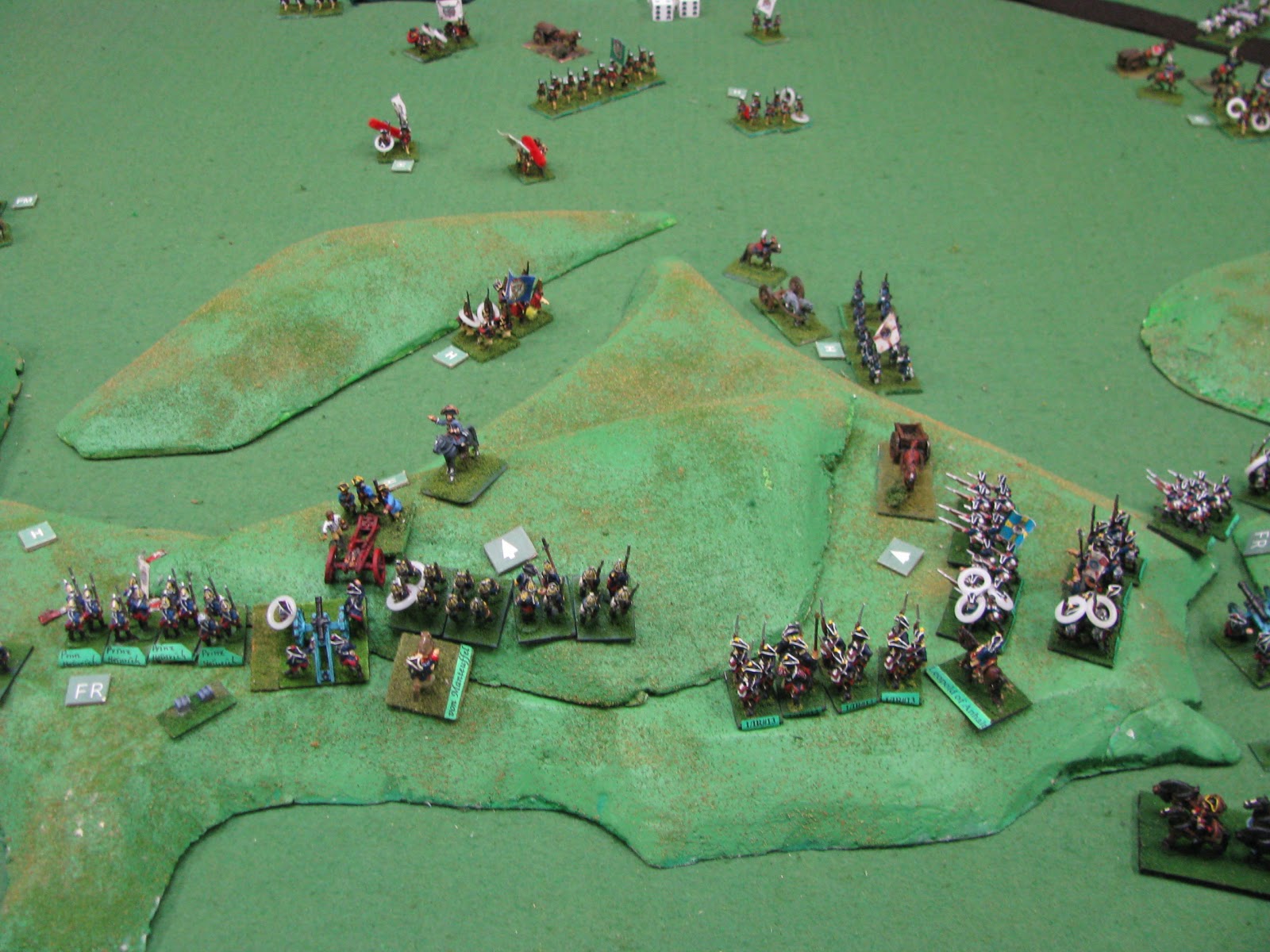
When last we left off, the Prussians and Brunswickers were going at it, hammer and tongs against the Hanoverians.  Yes, I know, not historical but what we felt like using.  Each side has enjoyed some success by loading up on their right and attempting to turn the other fellow's left.  Unfortunately for the Hanoverians, the Prussians were a couple of turns ahead in the process.

The first turn of the second session saw a series of disastrous morale tosses for the Hanoverians.  That coupled with a combination of Prussian musketry utilizing selective "First Fire" orders and a series of charges left the right side of the line looking rather empty.

Several units streamed to the rear either "Shaken" or routed.  Unfortunately, the rallied and reformed Prussian cavalry sporting a new commander was there to pounce.  The von Stechow dragoons bagged the first of two standards taken by them in the action.

On the other right, the Hanoverian cavalry swept forward and scattered the Prussian hussars and Freikorps cavalry.  But significantly, did not break them.  Light troops began to infiltrate among the ravines, sniping on flanks and whittling down Prussian units that would then be charged.


Back on the Prussian right things continued to go poorly for the Hanoverians.  A cascade effect began to hit as units realized that other battalions from their brigade had been destroyed, weakening their resolve further.  When the von Stechow dragoons nicked their second flag of the battle it well and fully signaled the end on the right.

Struck down in the moment of victory

Some very old and tired dragoons finally rout

The question still remained about whether the Freikorps and Brunswickers could hold on the left.  Their resolve and resistance stiffened, sensing victory elsewhere and they conducted a skillful defense against their aggressive opponent.  The Prussian fusilier brigade seemed about to break through in the center, when a chance musket ball dropped their commander.  For long minutes they milled about, unable to take advantage of the situation till a replacement could be found.  Then, with command reasserted the destruction of the Hanoverian right and center was completed.  Allowing cavalry to begin relocating to the left.


In the end the Prussian left bent, strained, but did not break.  The end of the ridge line was still contested for the moment, but the rest of the Hanoverian army was running and the victorious Prussians were bearing down on the left.

The battle was signalized by much laughter and merriment, occasionally at the expense of the opposition but also with the cross-table knuckle bump.  As always The Final Argument of Kings gave us an enjoyable game with lots of tactical nuances but also speedy resolution.  Had we not stopped for pizza and to watch the best part of "The Wind and the Lion" we would have been done even sooner.

As they say, "wait till next time."


Monday, October 15, 2012

Sausage and Sauerkraut Fest - Part One

We kicked off the fall gaming season with an all German (hence the title) battle royal using our favorite, The Final Argument of Kings.  We've been play-testing the 2nd edition rules and this time took extra care to make sure we implemented all the changes.  As a result it slowed the game a bit to make sure we didn't miss anything, but was worthwhile.

The "fantasy" battle features 21 Prussian and five Brunswick battalions, nine cavalry regiments and seven batteries facing off against 28 Hanoverian battalions, eight cavalry and a similar number of guns.  The center of the table is dominated by a ridge line which overlooks a Prussian city off table.  Control of it by the Hanoverians would endanger the city from siege guns, so the Prussian army must deny it to them.  The Prussians naturally have the best infantry on table, but also the worst since they have a brigade of Freikorps.  The Prussian cavalry is also a notch above the majority of the Hanoverian, with von Seydlitz leading them.

Prussian right, with the "heavies"


Prussian center with fusiliers and musketeers


Prussian left with the light cav, Freikorps and Brunswickers


The Hanoverian left with some new units

Because of the blind nature of the approach, we opted to do a double move at the beginning.  This led to units being closer together when they sighted each other than we are used to.  No artillery hammering the approaching lines and columns, just a "hammer and tongs" result right away.  Since both sides wanted the ridge line, the onus was on each side to make a play at it. 

Looking for left to right after the double move

On the Prussian right, Seydlitz (Dan) unleashed the cavalry in an all out charge.  Since we were starting so close together he was able to close with the also charging enemy before there was any risk of falling into disorder.  The Garde du Corps in a supported charge crashed into some fine hussars (also supported), threw them back, followed up and meleed them to extinction.  The regimental standard of the hussars passed into joyful hands of the Prussians.  Other units followed up, though they were exposed to some murderous flanking fire of the reacting Hanoverians in turns to come.

Cavalry "before" photo

Cavalry "after" photo

The Prussian right had a grenadier brigade leading a musketeer brigade as the main thrust.  Fearful (I know, not Prussian of me) of being charged while moving, we elected to form in place, while the Hanoverians moved forward and formed line with a "front to flank" maneuver at the end.  As a result, they had the edge on the contest for the ridge.


In the turns that followed the Prussians labored up the hill and engaged the Hanoverian infantry frontally while the Prussian cavalry turned and began riding down and eliminating units.  This meant that the expected bloodbath wasn't as bad as it could have been for the grenadiers, who were able to keep three of the four battalions in fighting order after clearing the ridge.  One battalion of musketeers, charged an enemy column and overcome with fiery impetuosity raced on, scattering other defenders still at last they stopped in front of fresh enemy forces.  With predictable results.


Coming to grips, with the rampaging musketeer shaken


Combined arms in action, all without player conversation

Much as I'd like to say that things were all going the Prussian way, on the left the main Hanoverian force and cavalry group were making slow but steady progress against the out-numbered Freikorps, Brunswickers and light cavalry.  The gallant von Seydlitz was struck down and his fate has not been determined, forced Der Alte Fritz himself to ride over and stabilize things till a successor can be named.  For a time the bulk of the Prussian cavalry milled about leaderless.


Cream of the Hanoverian cavalry early on

So the battle hangs in the balance, with each side attempting to turn the others right.  The game will be continued on Wednesday night.  Check back for the exciting conclusion.

Friday, October 12, 2012

What's new with me

Okay, so kind of an ego-centric title, but I suppose you have to be a bit so inclined to have a blog in the first place.  :-)


Things have been rather quiet here for some time with far fewer postings than normal.  Happily, it is just because life has been very full and rich so no health issues for a change.  On the downside, if life is too rich you risk gout. 

In August and early September I enjoyed six weekends in a row of historic reenacting.  On the downside again, no two weekends were in the same gear as I did: War of 1812 95th Rifles, Royal Navy, French Napoleonic, Rev War British, French and Indian War French, and War of 1812 British/Napoleonic French.  The last event was a dual War of 1812 and Napoleonic gathering so I donned uniform as appropriate to the planned skirmish.  While I regret none of the events, the pace was gruelling and led to a nasty head cold for me and bronchitis for my wife.
Can you find me?  Hint: I'm a redcoat.

Gaming wise I slipped in two games but neglected to take my camera to either.  My cell phone takes such dubious ones that it didn't seem worth doing. 

The first game was a semi modern game (1989) featuring the Soviet invasion of Germany.  I'm not sure of the rules, they were a modified sci fi system I believe.  The basic element was a platoon, so my battalion of T-80s was 10 micro scale models.  The game featured an initiative roll to start, then an IGO-UGO to complete the turn.  As the Soviets had more units, they tended to get some "end of turn" moves.  All a d6 game, where most vehicles got a saving throw against the hits (Abrams needed only a "2+" roll) and infantry evaporated fairly fast.  It tended to hit most of my pre-conceived notions of modern combat, which ordinarily doesn't appeal to me, and gave a very reasonable result.  In the end the Soviet tank regiment had two of the three battalions combat ineffective (routed or burning), were going to occupy the objective, and the Americans had sold their lives dearly.  3:1 odds seemed about right.  My main quibble was with the mechanics that gave it a chess-like feel.  If you fired on a unit (not stand) it took a "blast" marker.  Artillery bombardments could give multiple blast markers.  Destroyed elements gave you blast markers.  When your blast markers matched the number of functional stands, you routed.  No rolls, just automatic.  In the case of the Americans, it had to be double the number to reflect their desperation.  Calling in a fire mission didn't happen immediately, so you tended to target the unit that had already had it's action so that they couldn't just move out of the bombardment.  You had recon units giving away their position by firing with some 14.5mm machine gun against the Abrams to give them that last blast marker.  Now admittedly, as far as the Abrams know the tracers are just to aid targeting some big nasty, but the automatics encouraged players to make decisions they might not in real life.  I'd play it again, though as I say post-1945 stuff is not my thing.


The second game I squeezed in was Napoleonic naval; I think Form Line of Battle.  The combat system was easy if too brutal for my tastes when you got real close.  We had one situation where a ship of the line took one raking shot and struck.  The odds were remote, but did it ever happen on first damage?  A deck of cards drove the action.  The first card for your side was a command and control type.  Reload, new orders, etc.  Then you had two move cards available for your side.  So it was possible that one side could get their command phase and both movement phases before the other side could do anything.  You could only fire each broadside once per turn, but it still created weird effects.  I'm usually favorable towards card driven games because of the "dramatic tension" it creates, but this felt decidedly wrong.  The laws of physics still apply (or should) and two castles of oak sailing on a converging course simply can't stop and have someone sail past, then you magically regain momentum and carry one.  Even an IGO-UGO system would be more palatable, though of course a game of simul movement with courses plotted is best.  My bias of course, but founded in 40 years of gaming.  The game itself tested the game system as the British strove to break the French/Spanish/Dutch line, enduring raking fire as they did so, but having the cards line up perfectly at the critical time.  No "Band of Brothers" this, more a "bunch of squabbling cousins" as half the British ships took the loooooong way around to engage, but as they came into battle fresh the surviving coalition ships could only make sail and flee.  As an amusing side note, although the rules as played did not allow you to aim high or low, inevitably criticals against the British brought down masts, and criticals against the allies took our hull, guns and crew.  One reason the losers could escape with as many as they did.

Painting has been hit or miss.  After a very busy first half of the year it has not surprisingly taken the back seat of late.  I've done some easy things like WWII armor and infantry, some harder things like 15mm Republican French (1796ish), and some bothersome things like 28mm Foundry Russian SYW cavalry.  After the last big battle I've reluctantly agreed that I need more armored cavalry.  So at least three more squadrons will be ready for the December game.

Lots of other game ideas rattling around in my head and finally some time to act on them.  But I will be going to Rock Con later this month so that takes away a weekend from the locals.  I hope to sample some new game systems along with old favorites.

Thanks for reading along, if indeed you didn't just skip to the end or quit part way through.  And may the odds be ever in your favor.
 

Thursday, September 6, 2012

Figure Bonanza

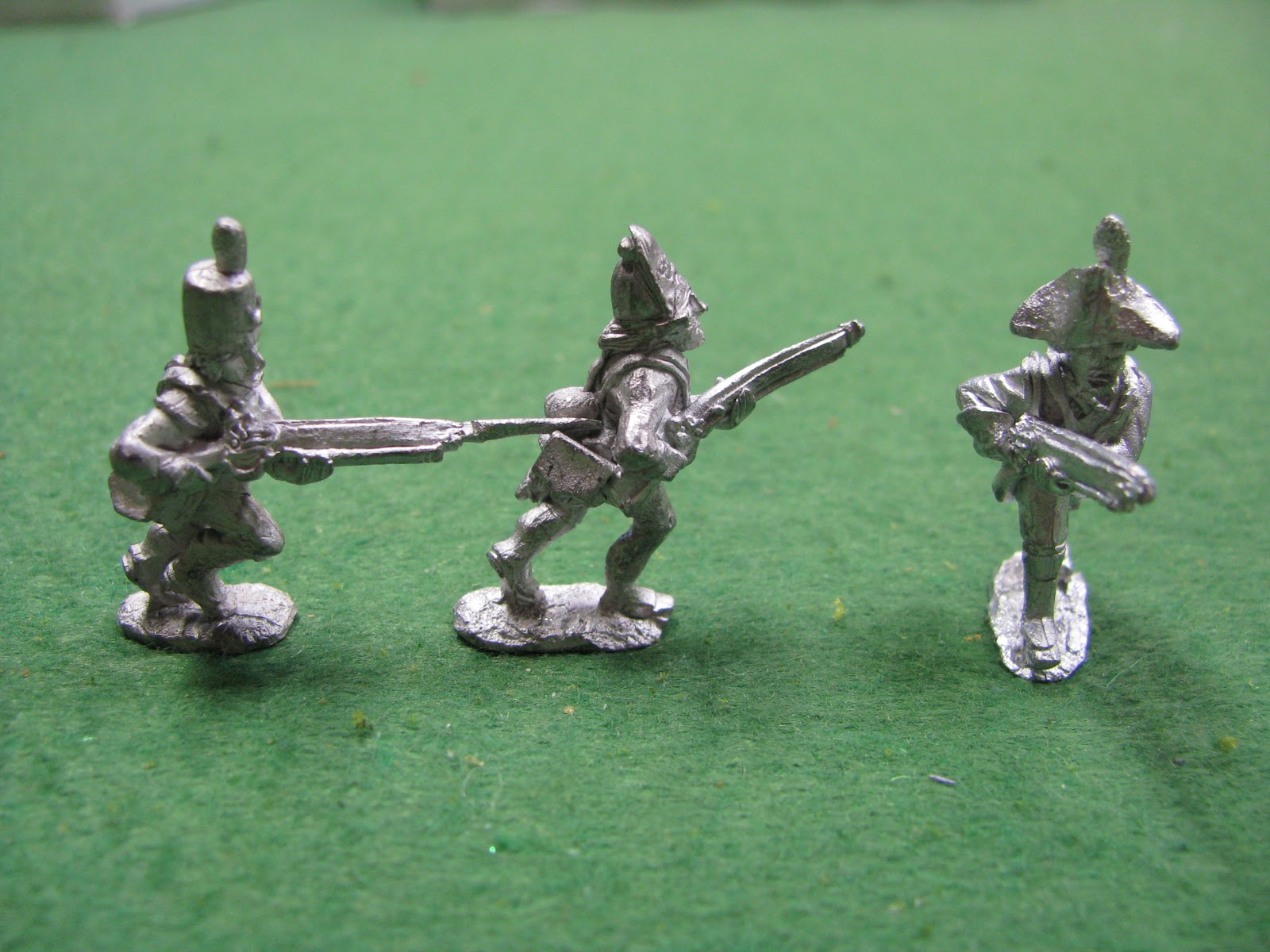
Our gaming group managed a huge haul off of eBay recently for AWI and F&I figures.  Unfortunately they aren't mainstream figures apparently because we are drawing a blank.  They run from tiny 25s (Musket Miniatures) to husky, robust types.  Some sample pictures are:


I think we can rule out Foundry, Front Rank and Redoubt for the first three pics.  They have tags like W66 on the bases.  The fourth picture of much smaller figures are AIF type tags, and the last picture has figures with no help at all but are more traditionally sized.

I've posted on The Miniatures Page as well, so hopefully we can get some direction to guide us in sorting out the stash.  We got some 2500 figures for our group.  Thanks!


Monday, August 20, 2012

Guns of the Mohicans

The advance guard of General Sydney Smythe-N-Jones moved through the wooded countryside, spotted with rolling hills and the occasional cut brook.  Ahead lay the main village of the natives allied with the damnable French.  Something that along with the small French settlement would be eradicated prior to the army moving on to the main French fort (TBA).

Colonel Locksley had a fine force at his command.  Elements of Lord Howe's 80th Lights, the provincial Ranging Company, two weak companies of grenadiers, half battalions of the 28th and 43rd RoF and Bagley's Provincials.  A galloper gun or two would have been nice, but they were with the main column, perhaps half a day behind.


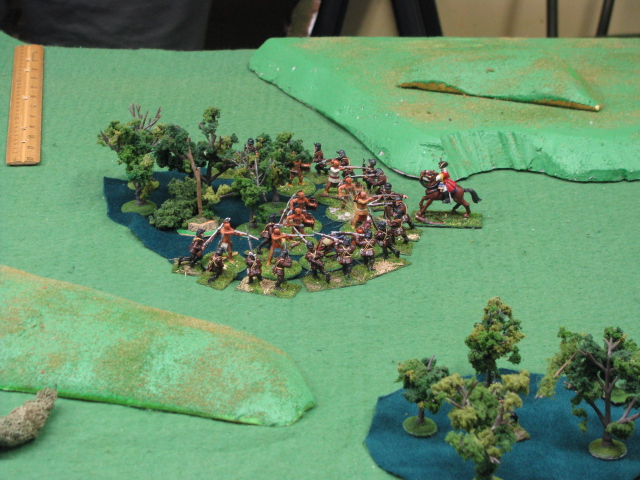
The lights were deployed on either wing and to the rear to prevent any unpleasant surprises from the wily French or Indians.  Action was quickly gained as the 80th swept around a wood that showed movement and discovered a warband of Indians.  Thinking their superior numbers would quickly overwhelm the natives they charged home and promptly lost the melee.  The rest of the column advanced but slowly, wanting to have flanks secured before pushing on.


The rangers on the left evicted another warband, though then spotted Coureur de Bois filtering down via a sunken stream.  They faced them off as the 80th went in again, this time with a mounted officer to inspire them.


Only to be defeated again and the officer carried from the field severely wounded.  (He survived.)  The third time proved to be the charm and the 80th carried the woods and sent the remaining members of the warband scurrying for home.


Meanwhile a large group of Canadian milicien with a regular officer took up a blocking position.  Two companies of troopes des colonies (aka. "Marines") were swiftly marching up.  Other small warbands steadied themselves for the coming advance.  The Coureur de Bois were overwhelmed and taken prisoner.


On the right the 43rd and the Provincials deployed into line to drive off the Indian skirmishers.  The remnants of the 80th, who had suffered greatly in the three melees, protected their flank.


The Canadians, seeing the grenadiers and 28th deploying thought the better of standing, and behind of screen of other militia moved back to join up with the colonial regulars at the big surprise, a formidable redoubt blocking the glorified game trail serving as a road.

Not at all sporting, the British attempted to charge the skirmishers, thinking to sweep them aside and hit the rear of the militia column. But in a confusion of order and counter-order, the normally steady infantry failed to charge. A missed opportunity.


A firefight broke out between la Marine and the two British units which did not favor the French, and then was followed by a charge against the disordered foes that succeeded.  Numbers and the martial quality of the grenadiers prevailed and the French were sent packing.


Leaving the indignant French commander in British hands.  The militia and remaining natives, seeing the ever flanking attempts by the 80th and Rangers taking place, decided to depart post-haste.  There is always another day.


Rules used were Guns of Liberty with the Guns of the Mohicans variant.  The British had a slight numeric advantage (88 castings to 80) and a noticeable qualitative edge, unless you were fighting Indians in the woods.  The British had to completely deploy first and then the French since we figured they were being watched ever since they left home.  Casualties have been noted and a follow-up game will take place in a month as the British attempt to finish dismantling the native village and settlement. 

A most enjoyable diversion from our usual game types and a chance for me to use part of my significant collection of 25mm figures.  Thanks to all and just wait till next time!


Friday, August 17, 2012

1805: Austerlitz by Robert Goetz

I recently completed a new book on an old topic that I very much enjoyed.  1805: Austerlitz by Robert Goetz.  Greenhill Books of London, 2005.  ISBN 1-85367-644-6.


At 306 pages of text, pictures and maps plus the appendices, it is a serious read.  Being a strong Napoleonic history aficionado, I jumped at it as soon as I saw the detailed maps and order of battle. 

Over the last 200 years a great deal has been written about the destruction of the Third Coalition, much of it contradictory or at least in disagreement on details.  Mr. Goetz has taken the trouble to go through and analyze the various accounts to arrive at a "most likely" conclusion.  Since it is backed up with evidence, it has high credibility with me.  The maps are particularly interesting because in most cases you can follow the path of a battalion or regiment throughout the battle.  This is no mean accomplishment on his part. 

While the battle is usually looked upon as a foregone conclusion, much like Trafalgar, but Mr. Goetz shows how hard the Russians and Austrians fought, giving them full credit for individual courage and skill.  Where he concludes the battle was won was in the planning rooms and in the minds of key leaders who did or did not react to the changing tempo of the battle.  A fair conclusion in my humble opinion. 

On the downside, if you do not have an abiding passion for things Napoleonic or of Austerlitz, it will be a dry read.  Though it is full of anecdotes from memoirs and such, the style of delivery isn't as exciting as the battle itself.  The wealth of data, which I ate up with gusto, may well put off other readers. 

In the end I learned a great deal about the battle that I only had a vague idea about before and have a renewed interest in gaming some elements of the battle, particularly the northern sector between Lannes and Bagration.  A chance to pit two charismatic leaders against each other.  Of course, the fact that I participated in the 200th anniversary reenactment just enhances my interest.

Serious work on snow and ice

Definitely canister range

The Santon


Saturday, August 4, 2012

Paper Boats

I have often in the past sung the praises of the Dave Graffam paper building models.  blog post  Now, in an effort to increase my water-borne options I assembled his Patrol Boat.  As with most of the PDF products, you have a choice of "layers" to vary things up.  I've scratch-built several small craft and longboats before blog entry but this promised to be easier.  So, below you can see my efforts, mixed in with some 25/28mm figures by assorted manufacturers.  By scaling the printing you can make them much smaller.  I used foam core board for the deck, but just common cardboard like you would find on the back of a pad of paper for the rest.  It came with a square mast that you could form but I preferred the dowel and base so it would be removed as needed.  The crate pictured below is one of three that come with the PDF.

Comments or suggestions welcomed, click the pictures to enlarge please.

Approaching shore where smugglers await

More emerge from below-decks

A scratch-built longboat on the right

I like the details and dingy sail
Keep an eye on your purse here